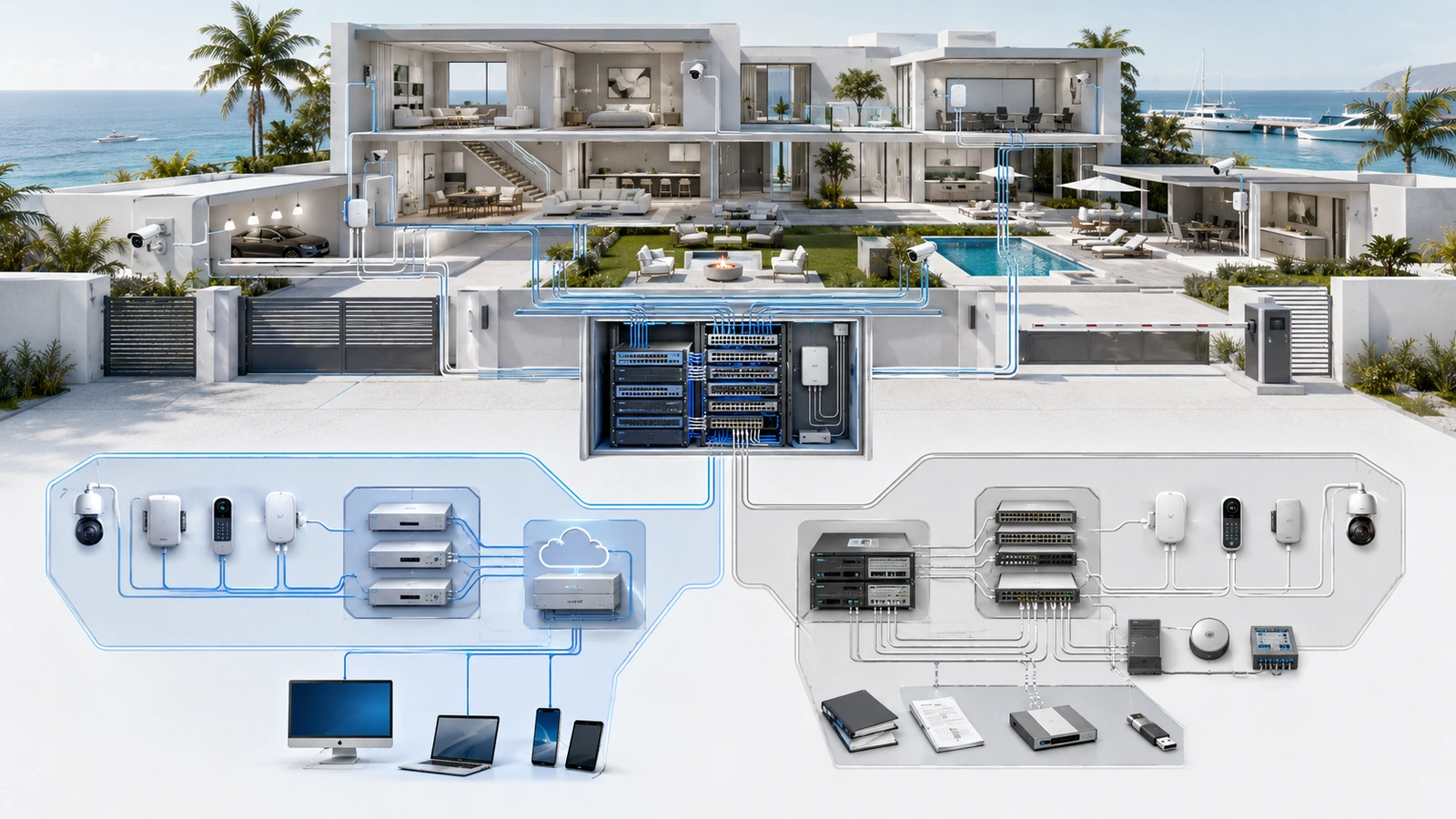
Integrated technology ecosystems can make residential infrastructure easier to deploy and manage.
A single platform may coordinate gateways, switches, wireless access points, cameras, access control, intercoms, automation, remote administration, alerts, and software updates. For a private home, HOA, condominium, or shared community facility, that simplicity can provide real operational value.
The risk appears when convenience gradually becomes dependency.
If the property cannot administer its own accounts, retrieve its data, obtain configuration backups, replace an individual component, select another qualified support provider, or continue operating after a cloud service changes, the environment may be locked in.
01 Lock-In Usually Begins With Legitimate Convenience
Most properties do not intentionally surrender control. They select an integrated platform because it solves immediate problems efficiently.
Common advantages include:
- One management interface
- Coordinated device configuration
- Centralized monitoring and alerts
- Simplified training and support
- Consistent software updates
- Fewer integration points
- Clearer responsibility during the original installation
These advantages should not be dismissed. Standardization can reduce complexity, and using a smaller number of well-selected platforms may be more maintainable than assembling unrelated products.
The problem is that the initial decision is often evaluated only through installation cost and everyday convenience. Less attention is given to what happens if pricing changes, a product is discontinued, the installer relationship ends, the cloud service becomes unavailable, or the property wants to replace only one part of the system.
A platform should therefore be assessed in two directions: how well it supports current operations and how safely the property can manage future change.
02 Lock-In Exists Across Several Layers
Vendor dependency is often discussed as a hardware-compatibility problem, but residential infrastructure can become locked in at several layers simultaneously.
| Lock-In Layer | Typical Dependency | Transition Risk |
|---|---|---|
| Hardware | Devices require proprietary controllers, recorders, accessories, or replacements | One failed component triggers broader replacement |
| Software and cloud | Management, authentication, recording, or automation requires a hosted platform | Service changes affect otherwise functional equipment |
| Licensing | Essential features depend on recurring device, user, storage, or support fees | Costs increase as the environment grows |
| Accounts and credentials | Administrative ownership remains with an installer, employee, or management company | The property cannot manage or recover its own system |
| Data and configuration | Records, footage, settings, or automation logic cannot be exported usefully | Migration requires rebuilding or losing history |
| Knowledge and support | Only one person or authorized provider understands the environment | Support interruption becomes an operational emergency |
A property may have standard cabling and replaceable hardware while still being locked in through account ownership or inaccessible configuration. Conversely, a proprietary device may present an acceptable risk if its role is isolated, replacement is straightforward, and the property retains its data and administrative control.
Lock-in should therefore be evaluated by consequence rather than by labels alone.
03 Property Ownership Must Extend to Digital Assets
Ownership of installed equipment does not automatically provide operational ownership of the system.
Critical accounts may be registered to a technician’s personal email address. Multifactor authentication may depend on a former employee’s phone. Cloud subscriptions may be billed through an installer. Configuration backups may exist only on a vendor laptop. Domains, certificates, licenses, or remote-access services may be controlled by outside identities.
Property-controlled ownership should normally include:
- Primary administrative accounts
- Subscription and billing relationships
- License registrations and renewal information
- Approved configuration backups
- Domain, certificate, and integration ownership where applicable
- Data-export and retention rights
- Multifactor-authentication and recovery arrangements
- Authority to add, change, or remove support providers
This does not require providing unrestricted access to every board member, resident, or staff member. Access should be controlled according to role, protected through appropriate security measures, and reviewed regularly.
The distinction is between secure delegation and loss of ownership. A vendor may manage the environment without being its sole unrecoverable owner.
04 Proprietary Hardware Can Turn One Replacement Into Many
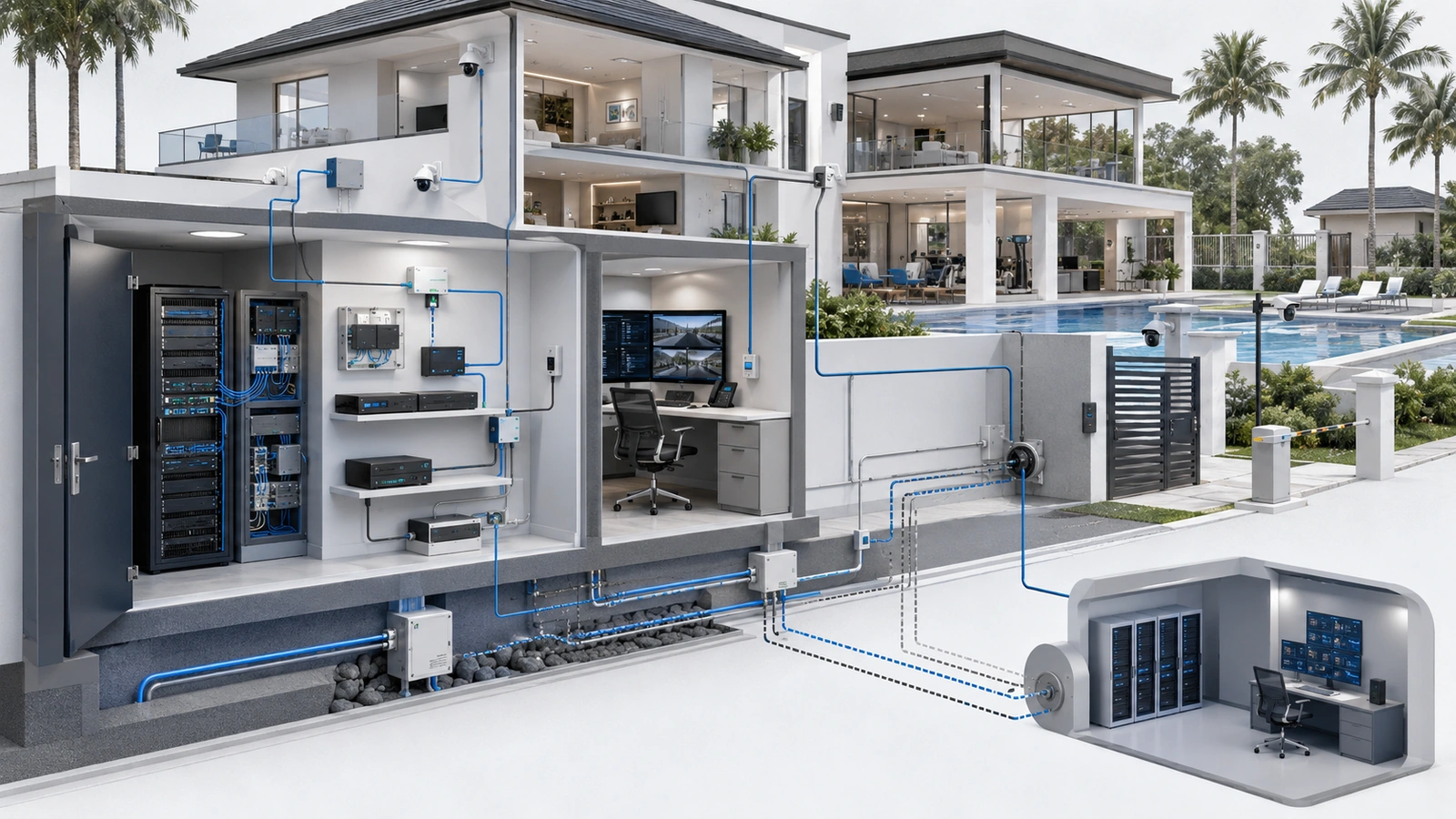
Tightly coupled platforms may require cameras to use a specific recorder, wireless devices to use a particular controller, access readers to connect through approved modules, or automation components to remain within one ecosystem.
This integration may improve compatibility, but it can limit component-level replacement.
Before deployment, the property should understand:
- Which components can be replaced independently
- Whether standard cabling and physical interfaces are used
- Which features require same-vendor equipment
- Whether replacement products remain available through multiple channels
- How discontinued devices affect the rest of the platform
- Whether third-party service providers can support the installation
- What must be replaced if the central controller or cloud platform changes
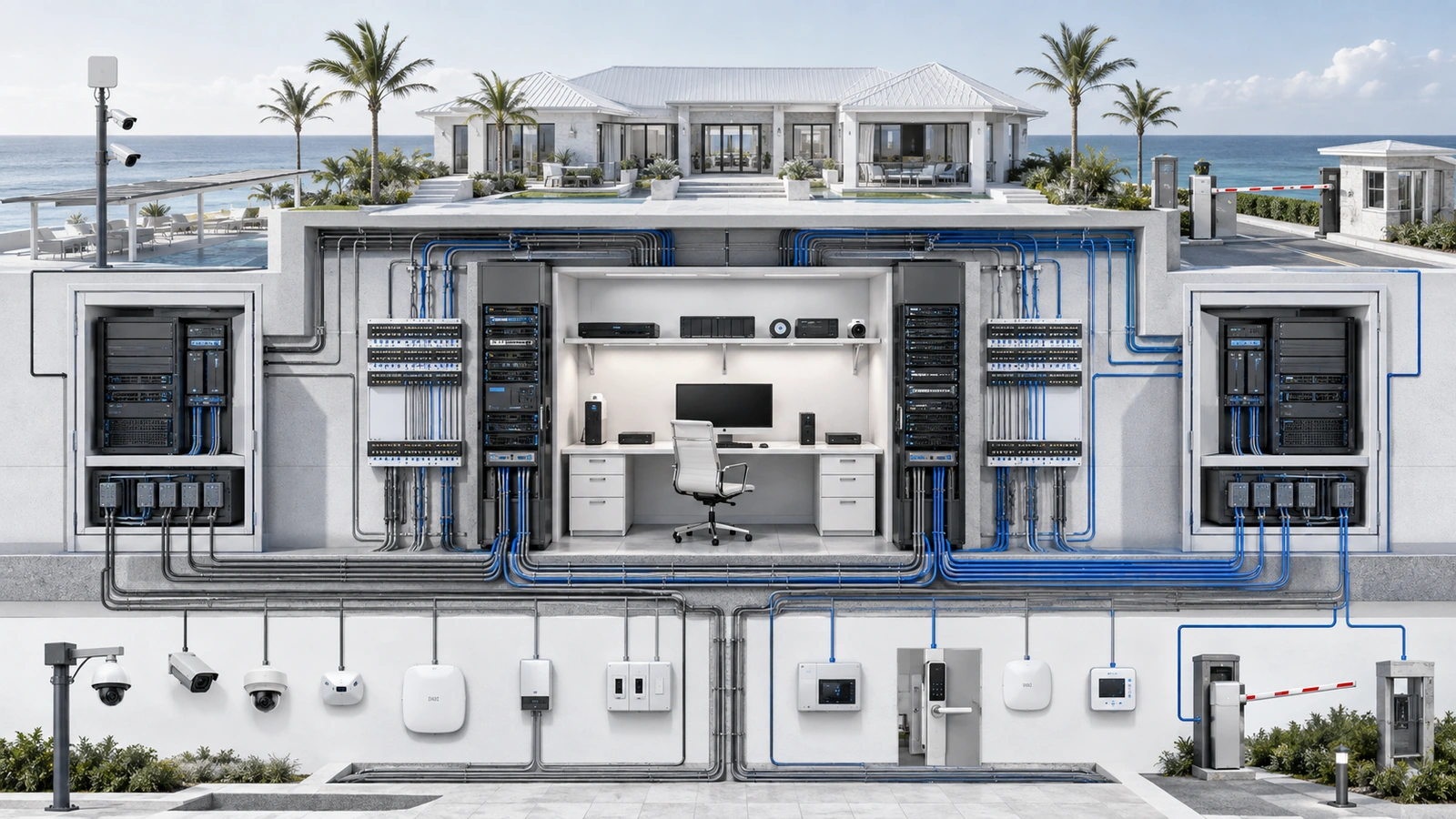
Physical infrastructure should remain as reusable as practical. Structured cabling, fiber backbones, pathways, racks, power, labeling, and environmental support commonly outlive the active equipment connected to them.
Preserving those durable layers can reduce the cost of a future platform migration even when proprietary active components must be replaced.
05 Subscription Costs Must Be Evaluated Over the Lifecycle
Recurring services can fund cloud hosting, security updates, remote management, support, storage, monitoring, and ongoing product development. A subscription is not automatically evidence of poor value.
The relevant questions are what the subscription controls, how costs scale, and what happens if it is not renewed.
Properties should model:
- Charges per device, door, camera, user, location, or storage tier
- Minimum contract commitments
- Expected growth in connected systems
- Data-retention and export requirements
- Premium support or required service agreements
- Pricing-adjustment and renewal terms
- Features that disappear when licensing ends
- Migration costs if future pricing becomes unacceptable
A low installation price may be offset by recurring costs over the system’s expected life. Equally, a higher recurring cost may be justified if it replaces meaningful internal labor, provides reliable support, and protects important operations.
The decision should use total lifecycle cost and operational consequence—not installation price alone.
06 Cloud Dependence Changes the Property’s Risk
Cloud platforms provide centralized management, remote access, mobile applications, automatic updates, multi-site visibility, and simplified vendor support. They also introduce dependencies outside the property’s direct control.
A responsible evaluation should determine:
- Which functions continue without internet access
- Which functions continue if the vendor cloud is unavailable
- Whether local administration remains possible
- Where operational data is stored
- How data can be exported and in what format
- How long data remains available after termination
- Whether the system can operate during a billing or licensing dispute
- What happens if the product or cloud service is discontinued
Cloud dependence may be acceptable where the operational benefit outweighs the risk and suitable contingency procedures exist. It becomes more concerning when critical local functions depend entirely on remote authentication or when the property has no practical migration path.
Properties should test and document offline behavior instead of assuming that a device continues working because it is physically located onsite.
07 More Vendors Do Not Automatically Create More Independence
A mixed environment can reduce dependence on one manufacturer by allowing networking, surveillance, access control, audio/video, and automation to evolve separately.
However, unnecessary fragmentation can create a different operational problem:
- Multiple incompatible management platforms
- Overlapping support responsibilities
- Duplicate hardware and subscriptions
- More administrative accounts to secure
- Complex troubleshooting between vendors
- Inconsistent documentation and maintenance standards
The goal is not maximum vendor diversity. It is deliberate modularity.
Systems should be separated where independence creates meaningful lifecycle or operational value and integrated where coordination clearly improves service. The boundaries between them should be documented, support responsibility should be assigned, and shared infrastructure should remain under property control.
A well-managed integrated ecosystem may be more sustainable than a poorly coordinated collection of supposedly open components.
08 Evaluate the Exit Before Approving the Entry
The best time to evaluate a transition is before the original platform is purchased.
Procurement and contract review should ask what the property will need if it later changes vendors, management companies, or technology platforms.
Important questions include:
- Who owns administrative accounts and operational data?
- Can configurations, logs, footage, user records, and other required data be exported?
- Are exports provided in documented, usable formats?
- Can another qualified provider obtain service access?
- What documentation and backups must be delivered?
- What notice, termination, and renewal terms apply?
- How long will data remain available after termination?
- Are licenses transferable to the property or another provider?
- What migration assistance is included or available?
- Which components can continue operating during a phased transition?
Promises made during sales discussions should be reflected in the applicable written agreement, scope, and handoff requirements. Contract interpretation and enforceability should be reviewed by qualified legal counsel where appropriate.
09 Transition Vendors Without Losing Operational Control
A vendor transition should be treated as a controlled technical and operational project. Immediate removal of the former provider before access, documentation, and dependencies are understood can create avoidable downtime.
Vendor Transition and Offboarding Checklist
- Inventory hardware, software, cloud platforms, subscriptions, and integrations.
- Confirm property ownership of primary administrative and billing accounts.
- Identify vendor-controlled identities, remote-access methods, and authentication dependencies.
- Secure current diagrams, configuration backups, licenses, warranties, and support records.
- Export required operational data before termination deadlines.
- Document systems that require proprietary support or replacement.
- Create a phased migration and rollback plan for critical services.
- Establish the incoming provider’s access before removing required legacy access.
- Rotate credentials, recovery methods, certificates, tokens, and shared secrets as appropriate.
- Remove former-vendor accounts and remote-access paths after transition verification.
- Transfer subscription, notification, billing, and renewal ownership.
- Test local operation, remote access, alerts, integrations, and recovery procedures.
- Update the authoritative documentation and record unresolved dependencies.
Credential changes should be coordinated carefully. Removing a working administrative account before replacement ownership is verified can lock the property out of its own system.
The documentation risks associated with vendor transitions are examined further in The Hidden Cost of Undocumented Networks.
Final Perspective
Vendor lock-in is not eliminated by rejecting every integrated platform, subscription, or proprietary component. That approach can sacrifice useful functionality while introducing unnecessary complexity.
The stronger objective is informed control.
A property should understand which dependencies it is accepting, what operational value they provide, how costs may change, who owns the accounts and data, which infrastructure remains reusable, and how the environment could be supported or migrated if circumstances change.
The best platform is not necessarily the one with the fewest dependencies. It is the one whose dependencies are understood, governed, appropriately documented, and acceptable throughout the intended lifecycle.