
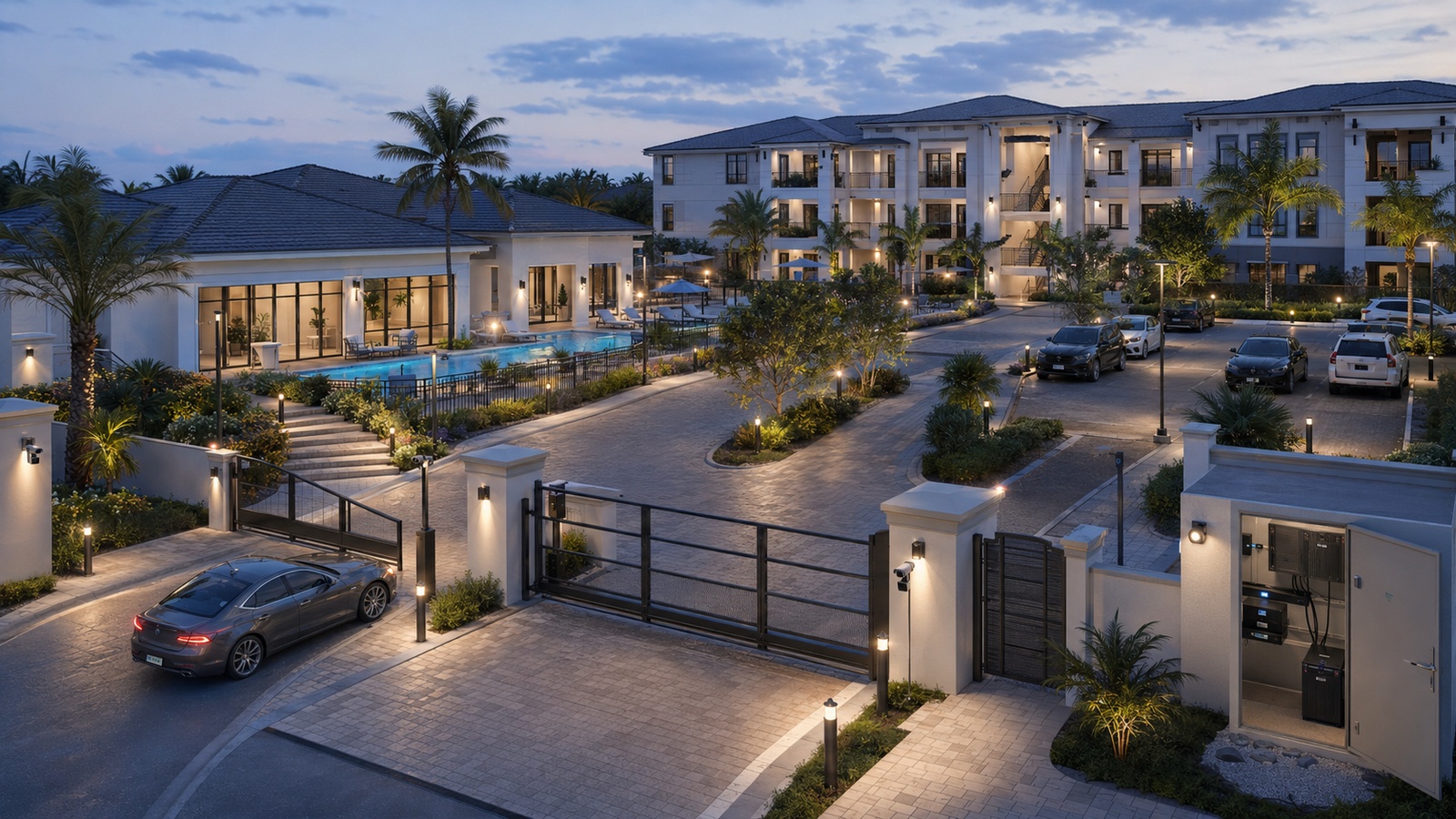
Lighting is one of the most visible infrastructure systems in a residential community. Residents immediately notice dark entrances, failed pathway fixtures, inconsistent landscape lighting, glare in parking areas, or amenity lights operating at the wrong time.
Smart lighting can improve this environment through centralized scheduling, zoning, monitoring, sensing, and energy control. However, connecting fixtures to software does not automatically produce a better property. Poorly planned automation can leave pathways unexpectedly dark, interfere with surveillance cameras, confuse maintenance teams, or create a system that nobody knows how to operate when the original vendor is unavailable.
A reliable design balances safety, visibility, appearance, energy use, maintenance, and operational simplicity. The objective is predictable illumination supported by understandable controls—not automation for its own sake.
Key Takeaway: Smart lighting succeeds when it delivers the correct illumination, in the correct area, at the correct time, while preserving safe fallback control and practical maintenance.
01 What Smart Property Lighting Includes
Shared residential lighting extends across many spaces with different operating requirements. A community may manage:
- Vehicle and pedestrian entrances
- Roadways, sidewalks, and walking paths
- Parking lots and garages
- Clubhouses and administrative areas
- Pool decks and outdoor amenities
- Fitness centers and activity rooms
- Building lobbies, corridors, and stairs
- Mail and package areas
- Landscape and architectural features
- Service, storage, and equipment spaces
- Emergency and egress lighting
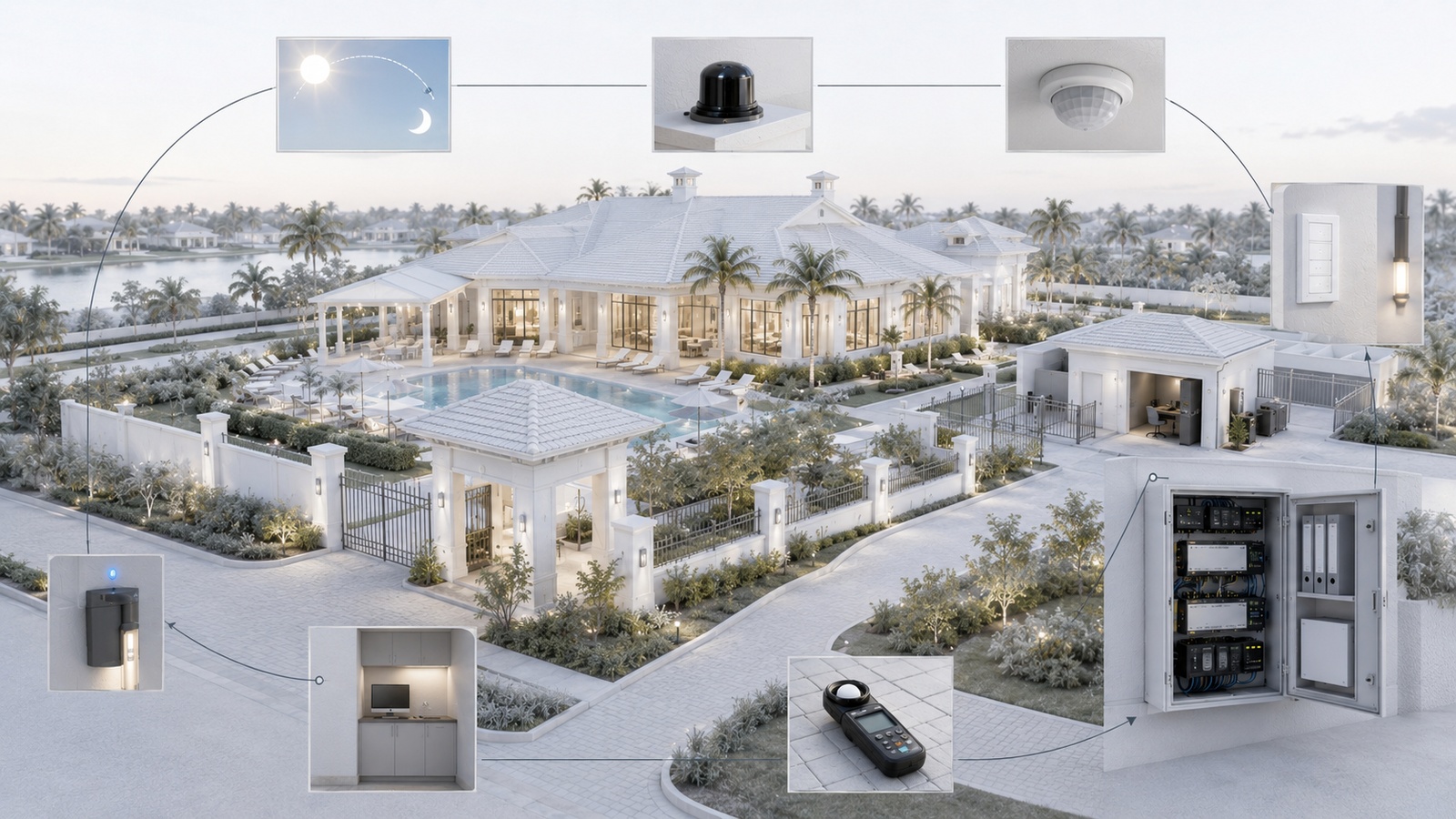
The word smart may describe centralized schedules, astronomical clocks, photocells, occupancy detection, dimming, energy measurement, failure reporting, remote administration, or integration with other property systems.
These functions do not need to exist everywhere. A service room may benefit from straightforward occupancy control, while a primary entrance may require consistent scheduled illumination with local manual override. A pool deck may follow amenity hours, but required egress lighting cannot be treated like decorative landscape lighting.
Smart-property planning therefore begins by classifying lighting according to purpose and operational consequence.
02 Divide the Property Into Meaningful Lighting Zones
A lighting zone is a group of fixtures controlled together because they share a location, purpose, schedule, or operating condition. Effective zoning makes the property easier to administer and prevents one change from affecting unrelated spaces.
| Zone Type | Primary Objective | Typical Control Approach |
|---|---|---|
| Safety and circulation | Maintain dependable visibility along entrances, paths, stairs, and travel areas | Predictable schedule or photocell with controlled minimum illumination |
| Security support | Support observation around gates, parking, equipment, and perimeters | Coordinated baseline lighting with carefully planned event response |
| Amenities | Match clubhouse, pool, fitness, and activity-area operations | Operating schedules with authorized local override |
| Service areas | Provide illumination when employees or vendors are present | Occupancy control or manual operation with suitable timeout |
| Landscape and architectural | Maintain property appearance without unnecessary overnight operation | Astronomical schedule, dimming, or curfew |
| Emergency and egress | Support required life-safety functions | Dedicated compliant equipment and controls |
Zones should remain understandable to the people who operate them. Dividing every fixture into an individual control point may appear flexible, but it can create unnecessary configuration and troubleshooting work. Conversely, placing the entire property on one schedule prevents practical adjustments.
Names should describe recognizable locations and purposes, such as “North Pedestrian Entrance” or “Clubhouse Exterior,” rather than unexplained controller numbers. Panel, circuit, relay, fixture, and software references should use a consistent naming convention.
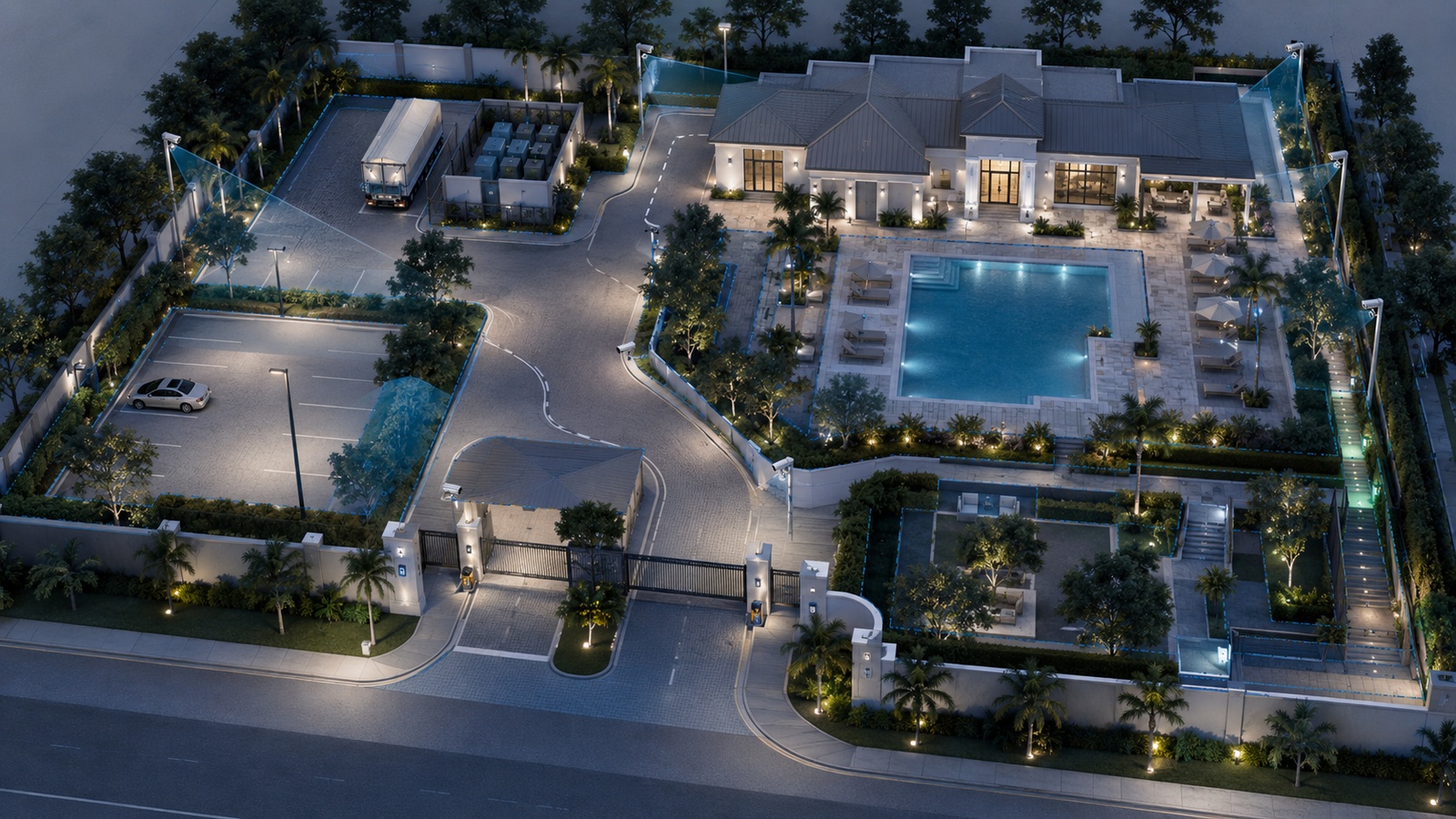
03 Choose the Appropriate Control Strategy
Different control methods solve different problems. Combining them without a clear hierarchy can create conflicting commands or unpredictable behavior.
Astronomical schedules calculate sunset and sunrise based on date and location. They are useful for exterior lighting because they adjust seasonally without frequent timer changes.
Photocells respond to actual ambient light. They can accommodate unusually dark weather but require appropriate placement and maintenance. A sensor affected by nearby fixtures, landscaping, dirt, or shade may produce incorrect behavior.
Motion or occupancy sensors can reduce unnecessary use in garages, storage rooms, service corridors, and other intermittently occupied spaces. Detection coverage, timeout, sensitivity, mounting, and minimum light levels must be planned carefully.
Time schedules suit amenities and areas with defined operating hours. Holiday events, seasonal use, cleaning, and after-hours maintenance may require exceptions.
Manual controls remain essential. Authorized staff should have a clear method to respond to events, maintenance, emergencies, or automation failure without navigating a complicated vendor portal.
A practical control hierarchy might establish required safety behavior first, standard schedules second, energy-saving adjustments third, and temporary authorized overrides last. The system should also prevent an old override from remaining active indefinitely without visibility.
04 Energy Efficiency Must Not Undermine Safety
Energy reduction is a legitimate goal, especially across large communities with hundreds of fixtures. Efficient luminaires, appropriate dimming, scheduled reductions, and occupancy-based control can lower consumption and maintenance burden.
However, the lowest possible energy use is not automatically the correct operating objective. Excessive dimming or delayed motion response can affect:
- Pedestrian confidence and visibility
- Stair, curb, and obstacle recognition
- Vehicle and pedestrian interaction
- Surveillance image quality
- Resident perception of safety
- Accessibility and wayfinding
Instead of turning a circulation area completely dark, some designs may use an appropriate baseline level and increase output when activity is detected. Whether that strategy is suitable depends on the environment, required illumination, fixture capabilities, and professional lighting design.
Communities should evaluate energy improvements using actual operating data and resident experience. A theoretical reduction that creates complaints, safety concerns, or frequent manual intervention may not represent a successful outcome.
Practical Principle: Energy optimization should occur inside safe and dependable operating boundaries. Critical visibility should not depend on a sensor detecting every person perfectly.
05 Coordinate Lighting With Cameras and Entrances
Lighting and surveillance should be planned together. A scene that appears well illuminated to the human eye may still produce poor recorded video because of glare, reflections, contrast, fixture placement, color, motion, or headlight exposure.
Entrance environments are particularly challenging. Cameras may need to observe vehicles approaching from darkness toward a brightly illuminated gate, capture license plates under changing headlights, or identify activity around an intercom without losing detail.
Coordination should evaluate:
- Fixture direction relative to camera views
- Bright and dark areas within the same scene
- Reflections from signs, pavement, glass, and wet surfaces
- Vehicle headlights and taillights
- Landscape growth that changes shadows
- Light color and consistency
- Motion-triggered transitions
- Nighttime identification requirements
Security lighting should not automatically mean maximum brightness. Excessive illumination can create glare, wash out subjects, disturb residents, increase light trespass, and make adjacent dark areas harder to observe.
The best validation occurs at the actual location after dark. Review live and recorded camera images during normal operation, rain, vehicle movement, and different lighting states rather than relying exclusively on daytime placement.
06 Connected Controls Need Reliable Infrastructure
Modern lighting platforms may use wired control buses, IP networking, wireless communications, local controllers, cloud portals, or combinations of these technologies. Each architecture creates dependencies that must be understood.
Connected lighting may require:
- Reliable local controllers and control wiring
- Structured network connectivity
- Protected switching infrastructure
- Appropriate wireless coverage
- Internet access for cloud administration
- Network segmentation and firewall policy
- Accurate time and location configuration
- Secure administrator and vendor access
- Configuration backups
Lighting should not simply join an unrestricted network shared with residents, guests, or unrelated smart devices. Management interfaces and controllers should be protected according to their operational importance.
The property should also know which functions continue without internet service. Local schedules and physical controls should normally preserve essential operation even if remote management is temporarily unavailable. A cloud outage should not require staff to wait helplessly while a critical entrance or pathway remains dark.
Wireless control can reduce installation disruption in some environments, but it introduces signal, interference, battery, range, obstruction, and compatibility considerations. Permanent infrastructure should be selected according to site conditions rather than convenience alone.
07 Outdoor and Coastal Conditions Change the Design
Exterior lighting infrastructure faces heat, rain, humidity, insects, irrigation, corrosion, landscaping, lightning activity, and power disturbances. Coastal communities must also account for salt exposure and accelerated deterioration.
A reliable outdoor installation may require:
- Appropriately rated fixtures, sensors, connectors, and enclosures
- Suitable conduit, junction boxes, and drainage
- Corrosion-resistant mounting and hardware
- Surge and lightning protection
- Protected control equipment
- Ventilation or thermal planning where required
- Accessible service locations
- Separation from irrigation and standing water
An enclosure’s rating does not compensate for poor installation. Cable entries, unused penetrations, seals, drainage, condensation, mounting orientation, and maintenance access all influence its long-term protection.
Landscaping should be reviewed as it matures. Trees and shrubs can cover fixtures, interfere with sensors, restrict cabinet access, trap moisture, or change the illumination pattern. Documentation should identify underground pathways so future landscaping work does not damage lighting and communications infrastructure.
08 Monitoring and Maintenance Keep Lighting Useful
Centralized monitoring can help operations teams discover failed fixtures, offline controllers, abnormal energy use, schedule errors, and power interruptions before residents report them. The value depends on the system’s ability to identify a meaningful fault—not merely indicate that a controller is online.
A connected controller may still appear healthy while a branch circuit, relay, driver, or individual fixture has failed. Properties should understand the actual level of visibility provided by the platform.
Useful alerts might include:
- Controller or communications failure
- Unexpected power loss
- Fixture or driver failure where supported
- Abnormal energy consumption
- Schedule or time synchronization problems
- Overrides remaining active beyond an approved period
- Environmental conditions threatening control equipment
Each significant alert needs an owner and response path. Excessive notifications create alert fatigue, while an unmonitored dashboard provides little operational value.
Preventive maintenance should address fixture condition, lens cleanliness, corrosion, seals, sensor coverage, controller batteries, surge devices, cabinet condition, vegetation, schedules, documentation, and replacement availability.
Broader system-health planning is covered in Remote Property Monitoring: What Modern Communities Actually Need.
09 Commission the System Under Real Conditions
Lighting should be tested after installation and whenever major programming, fixture, landscape, or surveillance changes occur. Daytime verification alone cannot reveal nighttime glare, dark transitions, reflections, sensor gaps, or camera conflicts.
Smart Lighting Planning and Commissioning Checklist
- Inventory every lighting area and classify its operational purpose.
- Create understandable zones instead of excessive individual controls.
- Identify safety, security, amenity, service, decorative, and emergency functions.
- Select schedules, photocells, sensors, and dimming according to the location.
- Provide authorized local controls and clearly defined override behavior.
- Prevent energy-saving logic from eliminating necessary visibility.
- Coordinate entrance and security lighting with camera views.
- Test glare, reflections, shadows, and transitions after dark.
- Verify controller behavior during network, internet, and cloud outages.
- Protect connected controllers and administrative access.
- Use appropriately rated outdoor equipment and protected pathways.
- Inspect surge protection, enclosures, drainage, corrosion, and vegetation.
- Assign responsibility for alerts, programming, maintenance, and vendor escalation.
- Document panels, circuits, zones, schedules, controllers, and configuration backups.
- Reevaluate performance seasonally and after material property changes.
Testing should include normal schedules, holiday conditions, manual overrides, power restoration, sensor activation, controller communication loss, and the return from a temporary override. Staff should be able to identify a zone, operate it appropriately, and escalate a failure without depending on one individual’s memory.
Exact illumination requirements and electrical configurations vary by location and use. Communities should coordinate final design with qualified lighting professionals, electrical contractors, and applicable authorities rather than applying one universal value to every space.
Smart lighting infrastructure should make the property more predictable. When zoning, controls, visibility, environmental protection, and maintenance are coordinated, lighting can improve safety, property presentation, surveillance effectiveness, and operational efficiency without becoming an unnecessary technology burden.
The next guide examines how communities can monitor lighting and other connected systems from one practical operational perspective: Remote Property Monitoring: What Modern Communities Actually Need.