
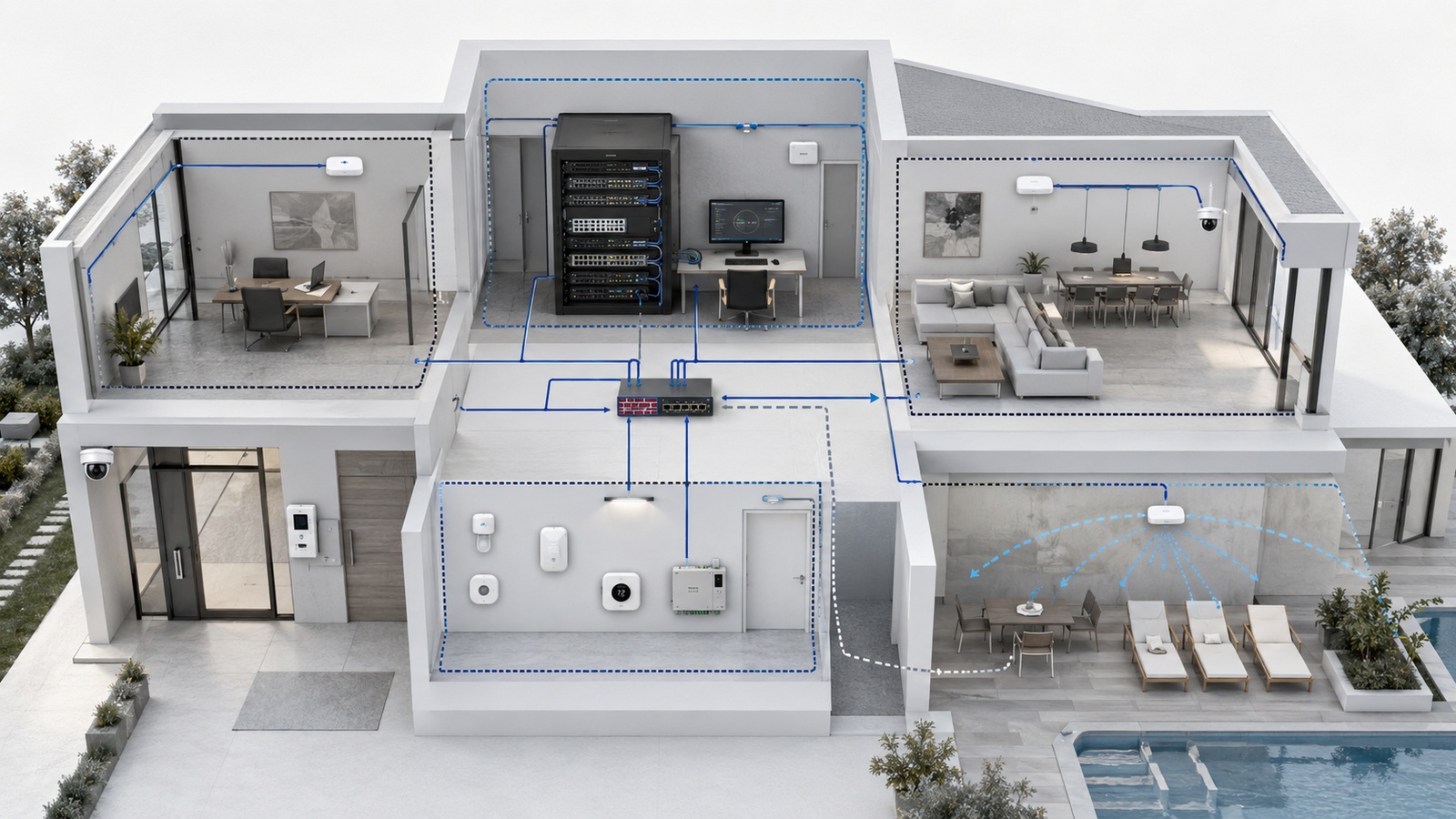
Smart properties may contain cameras, access-control panels, gate controllers, intercoms, lighting systems, thermostats, environmental sensors, pool automation, audiovisual equipment, building controllers, and vendor-managed appliances. These devices do not all have the same purpose, security capability, owner, or operational consequence.
When every system shares one unrestricted network, unrelated devices may communicate more broadly than necessary. A problem involving one platform can become harder to contain, and troubleshooting becomes more difficult because resident, guest, vendor, and infrastructure traffic are mixed together.
Segmentation creates intentional boundaries. It can limit unnecessary communication, protect management interfaces, improve visibility, and reduce selected lateral paths. However, it must be designed around the communications the property actually requires. Poorly planned segmentation can interrupt controllers, mobile applications, video recording, casting, printing, alerts, and vendor support.
Key Takeaway: Effective IoT segmentation does not isolate every device blindly. It creates a small number of meaningful trust zones and permits only the communication required for dependable property operations.
01 Why Smart Properties Need Boundaries
Connected property systems often remain installed much longer than ordinary computers and phones. Some use embedded operating systems, vendor-specific applications, infrequent updates, hardcoded communications, or limited administrative controls. Others may be managed remotely by an external contractor.
Segmentation can help address several practical concerns:
- Guest devices should not reach property controllers.
- General IoT products should not freely access administrative systems.
- Vendor-managed equipment should have limited reach into unrelated infrastructure.
- Resident traffic should not interfere with shared operational systems.
- Camera and access-control networks should be easier to identify and troubleshoot.
- Management interfaces should be reachable only by authorized administrators.
A flat network is not automatically compromised, and segmentation does not guarantee that a system is secure. Endpoint authentication, software maintenance, secure administration, physical protection, backups, logging, and vendor governance remain necessary.
Segmentation is best understood as one layer of risk reduction and operational control. It narrows selected communication paths and makes the intended architecture more explicit.
02 VLANs, Subnets, SSIDs, and Firewalls Are Different
Several networking terms are often used interchangeably even though they perform different functions.
| Component | What It Does | What It Does Not Prove |
|---|---|---|
| VLAN | Creates a logical Layer 2 network boundary | That traffic between networks is securely restricted |
| Subnet | Defines an IP address range and routing boundary | That devices inside or outside it have appropriate permissions |
| SSID | Provides a named wireless connection | That it maps to a separate network or has client isolation |
| Firewall policy | Permits or denies routed communication according to rules | That applications will function without documented dependencies |
| Client isolation | Restricts direct communication among selected wireless clients | That wired devices or other routed paths are protected |
A separate wireless name does not prove actual segmentation. Two SSIDs may still place clients on the same network. Similarly, two VLANs can communicate broadly if routing policies allow unrestricted traffic between them.
The firewall or Layer 3 policy is what enforces communication between routed zones. Rules should address both IPv4 and IPv6 where both protocols are available. Disabling or overlooking IPv6 while enforcing only IPv4 can create inconsistent boundaries.
Network address translation may change addresses between networks, but NAT is not a replacement for an intentional firewall policy.
03 Start With an Inventory and Communication Map
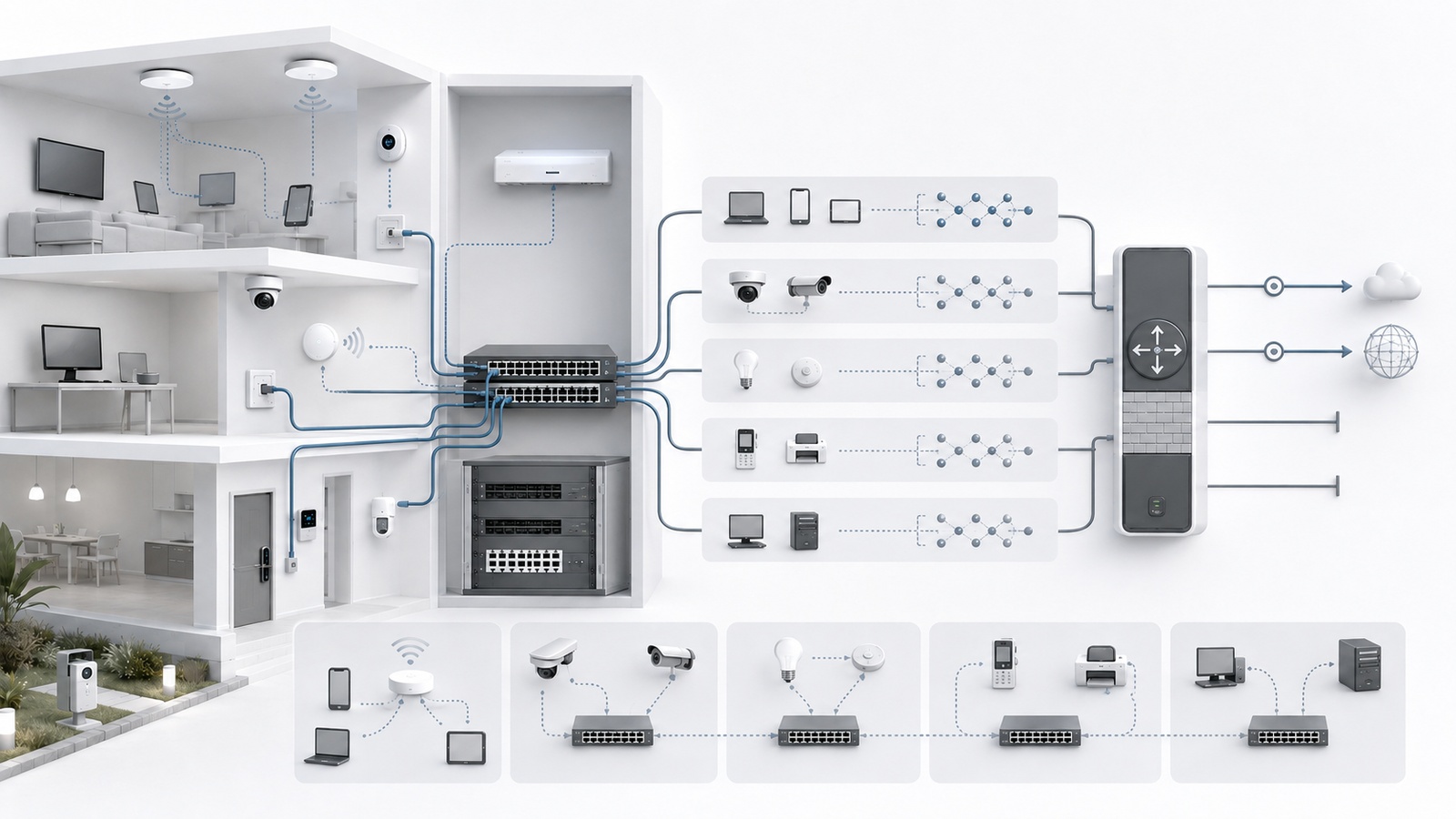
Segmentation should begin with devices and workflows—not with VLAN numbers. Inventory the property’s systems, ownership, location, management method, network connection, criticality, and expected lifecycle.
For each system, determine:
- Which local devices it must contact
- Whether it requires internet or cloud access
- Which administrators manage it
- Whether a vendor supports it remotely
- Which protocols or ports are required
- Whether it uses broadcast, multicast, or local discovery
- How it receives DNS and accurate time
- What continues during an internet outage
- What operational consequence follows a failure
A communication matrix can then describe the required flows. For example, cameras may send video to a local recorder and accurate time to a trusted time service. Administrative workstations may reach the recorder’s management interface, while guest devices should reach neither.
Unknown communication requirements should be investigated before restrictive rules are applied. Temporary observation, vendor documentation, controller logs, and controlled testing can help identify dependencies. “Allow everything permanently” should not become the default solution merely because documentation is incomplete.
04 Use a Proportional Zone Model
The right number of zones depends on property size, platform capabilities, staffing, risk, and support maturity. A smaller residence may use three or four boundaries. A large community may justify additional separation between buildings, operational systems, and administrative environments.
A practical shared-property baseline may include:
| Zone | Typical Systems | General Policy Direction |
|---|---|---|
| Management | Approved admin workstations, management interfaces, monitoring tools | Highly restricted; used only for authorized administration |
| Security operations | Access control, gate controllers, intercoms, cameras, recorders | Permit required local controllers, monitoring, cloud, and admin paths |
| Building IoT | Lighting, HVAC, environmental sensors, pool and amenity controllers | Restrict lateral and management access while preserving required services |
| Private or staff | Resident, office, or authorized operational user devices | Permit business or private resources according to role |
| Guest | Visitor and public internet clients | Internet access with isolation from property infrastructure |
This is a planning model, not a universal configuration. Surveillance may deserve its own zone because of scale, bandwidth, retention, or administration. Access control may be separated from cameras when the property’s operational requirements justify it. A high-rise may also separate building systems by tower or equipment location.
The strongest architecture is not necessarily the one with the most VLANs. Every additional zone creates addressing, firewall, switch, wireless, documentation, monitoring, and troubleshooting requirements.
Practical Principle: Create a separate zone when it represents a meaningful difference in trust, ownership, function, or consequence—not merely because another VLAN is technically possible.
05 Design Firewall Policy From Required Flows
A useful starting principle is to deny unnecessary communication between zones and explicitly permit documented services. The resulting policy must remain understandable enough for future administrators to maintain.
Typical directions may include:
- Guest devices may reach the internet but not private or operational networks.
- IoT devices may reach required controllers, DNS, time services, and approved cloud endpoints.
- Cameras may reach designated recorders but not administrative workstations.
- Management devices may administer approved controllers through restricted paths.
- Vendor access may reach only the supported platform during an authorized window.
- Operational devices should not initiate unnecessary connections to unrelated zones.
Stateful firewalls normally allow response traffic for an established permitted session. Administrators should not create broad reverse-direction rules simply because replies must return.
Rules should use descriptive names, defined sources and destinations, justified services, responsible owners, and review notes. Broad rules such as “IoT to Any” obscure the intended boundary and make later cleanup difficult.
Domain-based cloud dependencies can be challenging because vendor endpoints and addresses may change. The property should use supported vendor guidance and the firewall platform’s appropriate capabilities rather than maintaining fragile assumptions.
06 Preserve Discovery, Controllers, and Cloud Services
Many smart-property systems rely on communication that does not cross routed boundaries automatically. Devices may use multicast DNS, multicast traffic, broadcast discovery, proprietary controller discovery, casting protocols, or local pairing mechanisms.
Commonly affected functions include:
- Mobile discovery of lighting or audiovisual devices
- Printing and casting across user and device zones
- Controller adoption or provisioning
- Intercom and application discovery
- Management-platform device detection
- Audio distribution and synchronized playback
The solution should not automatically be to permit all multicast or merge the networks. Where necessary, a supported discovery gateway, multicast relay, controller configuration, or narrowly scoped firewall policy may expose only required services between approved zones.
Some systems communicate through the cloud even when the user and device are on the same property. Others require direct local communication. These behaviors should be verified rather than assumed.
DNS and time synchronization are frequently overlooked. Certificate validation, event correlation, camera recordings, access logs, schedules, and automation may all depend on accurate time and working name resolution.
07 Protect the Management Plane and Vendor Access
Separating IoT traffic has limited value if anyone on the property network can open the gateway, controller, switch, camera, or access-control administration page. Management interfaces deserve stronger protection than ordinary device communication.
Recommended controls include:
- A dedicated management zone or equivalent protected path
- Named administrator accounts
- Multifactor authentication where supported
- Approved administrative devices
- Encrypted management protocols
- Configuration and database backups
- Logging of administrator and policy changes
- Secure account-recovery ownership
- Periodic review of users, tokens, and integrations
External vendors should not receive permanent unrestricted access to the property network. A controlled support method should identify the vendor, supported system, authorized period, permitted destination, approval owner, and activity record.
Where practical, vendor access should be enabled when needed and removed or disabled afterward. Shared vendor accounts reduce accountability and complicate revocation when personnel change.
Physical protection also matters. An exposed switch port, controller cabinet, reset button, or console connection can bypass carefully designed network restrictions.
08 Migrate and Test Without Disrupting Operations
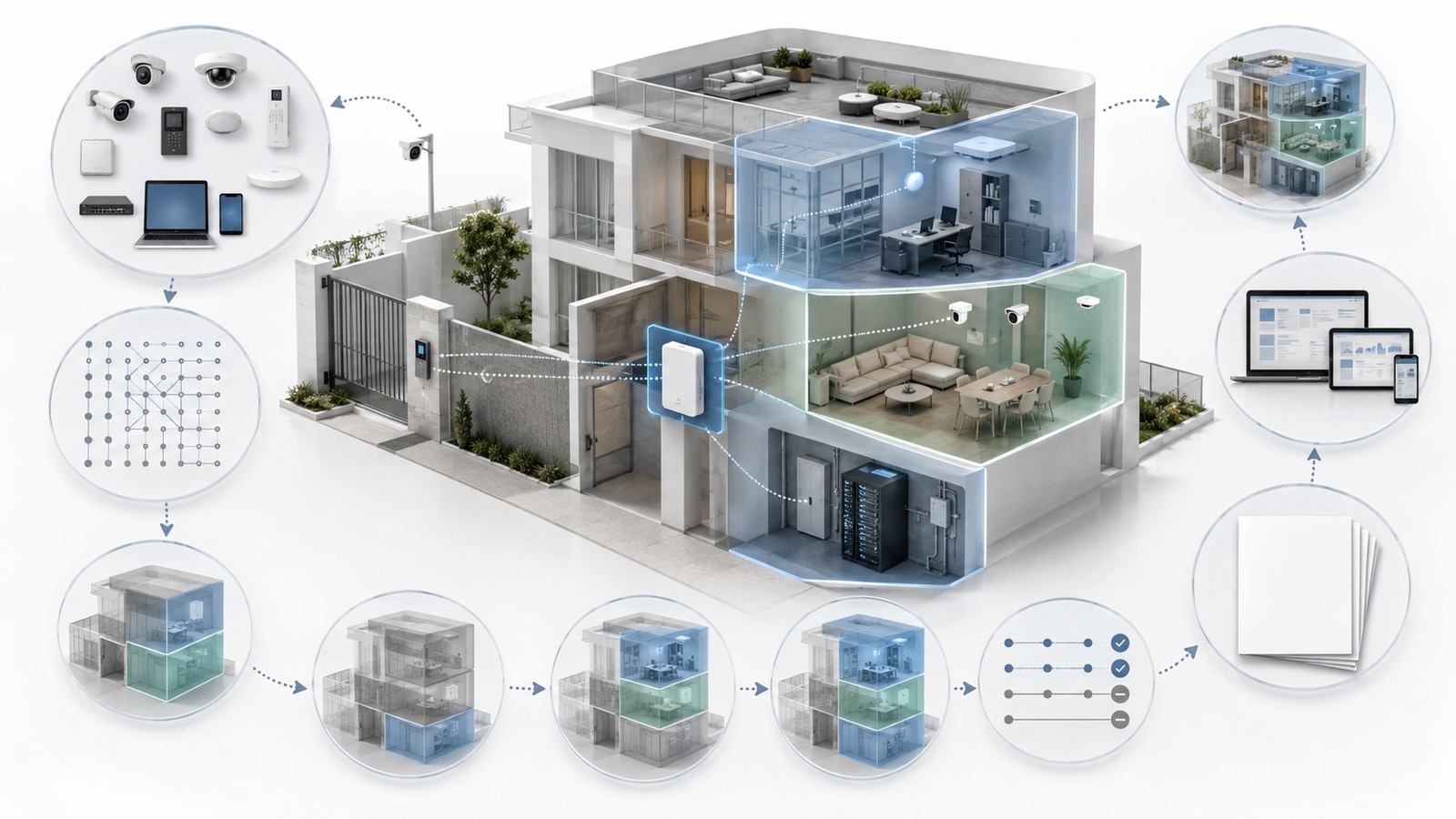
Moving an operating property from a flat network to segmented architecture should be phased. Changing every system simultaneously makes failures difficult to isolate and can affect entrances, cameras, lighting, or environmental monitoring.
A controlled migration may proceed by:
- Documenting the existing network and device dependencies.
- Creating the new zone, addressing, DHCP, DNS, and firewall policy.
- Moving a limited set of low-risk or test devices.
- Validating local controllers, cloud access, monitoring, and administration.
- Testing required discovery and multicast behavior.
- Moving the remaining devices in planned groups.
- Monitoring logs and operational performance.
- Updating diagrams, inventories, and rollback records.
Testing must verify both allowed and blocked communication. Confirming only that a camera records or a light responds does not prove that guest devices are unable to reach its management interface.
Tests should include IPv4 and IPv6 paths, internet outages, controller availability, mobile applications, alerts, vendor support, time synchronization, firmware updates, and restoration after power loss.
09 Maintain Segmentation as the Property Changes
Segmentation is not a one-time installation. New controllers, cameras, appliances, amenities, vendor platforms, and cloud integrations can gradually weaken or bypass the original architecture if changes are not reviewed.
Smart Property IoT Segmentation Checklist
- Inventory devices, owners, locations, criticality, and management methods.
- Document local, cloud, controller, DNS, time, and discovery requirements.
- Create zones based on trust, ownership, function, or consequence.
- Keep the number of zones proportional to operational capability.
- Confirm that SSIDs map to the intended VLANs and subnets.
- Enforce boundaries with documented firewall policy.
- Apply consistent IPv4 and IPv6 restrictions.
- Preserve only required discovery and multicast communication.
- Protect management interfaces with named accounts and MFA.
- Restrict vendor access to approved systems and time periods.
- Back up gateway, switch, controller, and application configurations.
- Migrate operating systems in controlled phases with rollback plans.
- Test both required access and prohibited paths.
- Update diagrams and communication matrices after every material change.
- Review rules, accounts, logs, and unused exceptions periodically.
Firewall exceptions should have an owner and a documented reason. Temporary troubleshooting rules should be removed after the issue is resolved. Unused zones, administrator accounts, and vendor integrations should be reviewed rather than left indefinitely.
Monitoring can help identify unexpected communication, offline controllers, repeated denied connections, or devices appearing in the wrong zone. Broader operational visibility is discussed in Remote Property Monitoring: What Modern Communities Actually Need.
Good segmentation should become nearly invisible to residents while remaining understandable to administrators. Property systems continue performing their intended functions, but unnecessary reachability is reduced and management paths are better protected.
The next article expands the planning horizon beyond today’s network and devices: Future-Proofing Technology Infrastructure in Residential Properties.