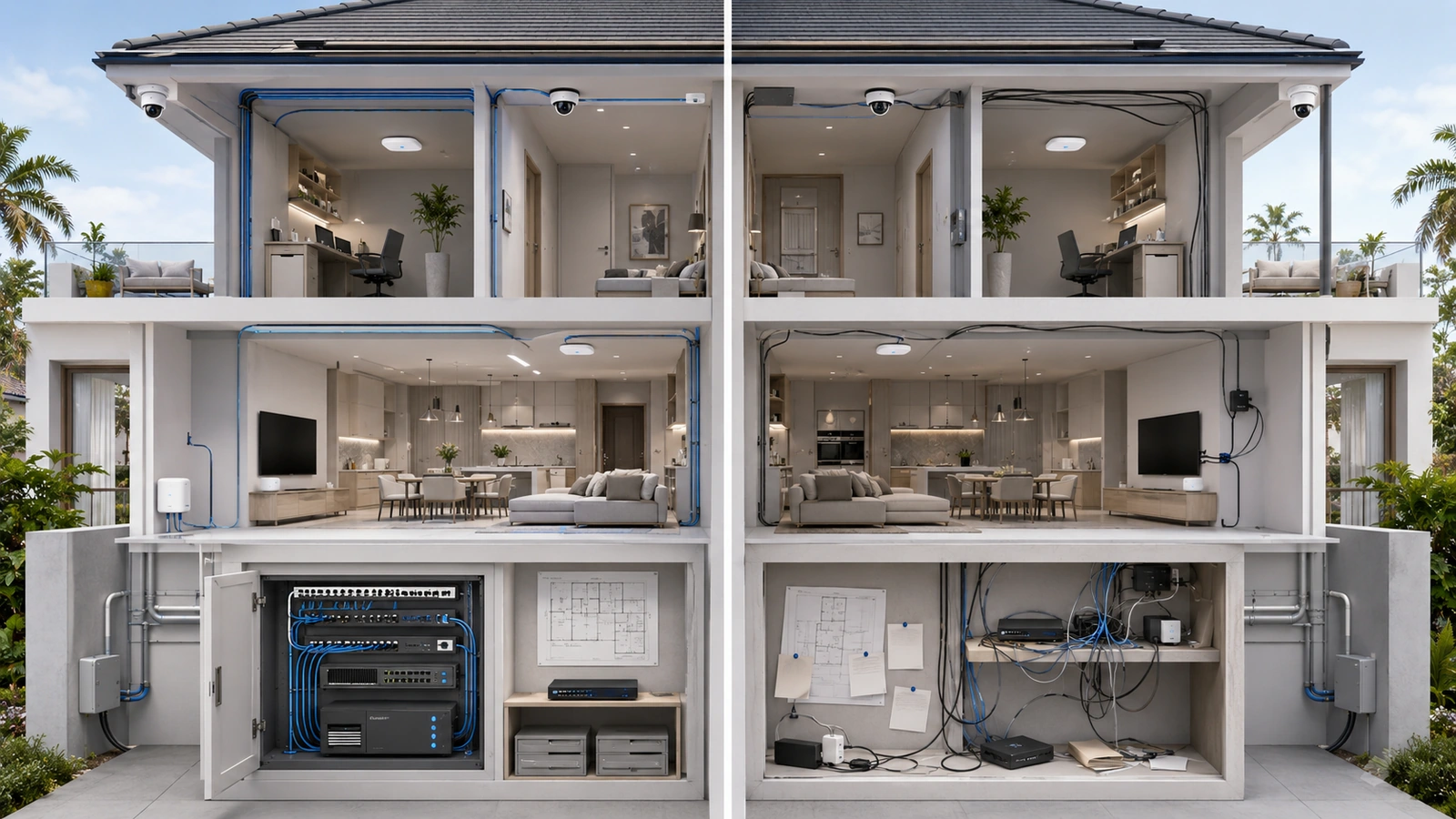
A property can have premium switches, professionally installed access points, enterprise-grade cameras, and a carefully configured firewall—and still be dangerously difficult to support.
The problem is often not the equipment. It is the absence of reliable information about how that equipment is connected, configured, owned, and recovered.
Undocumented networks rarely create an obvious crisis on the day they are installed. Internet service works, cameras record, access systems respond, and staff continue operating. The hidden cost appears later, when a circuit fails, a vendor changes, a device must be replaced, or an expansion project begins.
At that point, what should have been a controlled technical task becomes a discovery project.
01 How Networks Gradually Become Undocumented
Most undocumented environments were not intentionally designed that way. They became undocumented through years of small, individually reasonable changes.
An internet provider replaces a gateway. A camera contractor adds a switch. An access-control vendor creates a remote-support account. A temporary cable is installed during an outage and never removed. A property manager changes, taking knowledge of several accounts and contacts with them.
Other common causes include:
- Multiple vendors working independently
- Emergency repairs performed without follow-up documentation
- Incremental equipment replacements
- Unrecorded configuration changes
- Internet provider and circuit changes
- Property-management or board transitions
- Former vendors retaining administrative access
- Temporary workarounds becoming permanent infrastructure
Each change may appear minor. Collectively, they create an environment where no single person can confidently explain the complete system.
The network may continue operating, but operational clarity has already begun to disappear.
02 What Network Documentation Must Explain
Useful documentation is more than a list of devices. It should allow an authorized technician or property representative to understand the environment without relying entirely on the memory of the original installer.
A practical documentation system should answer several basic questions:
- What equipment exists, and where is it located?
- How are major systems physically and logically connected?
- Which systems depend on internet, power, cloud services, or other devices?
- Who owns the accounts, licenses, warranties, and service agreements?
- Where are approved configuration backups stored?
- How can authorized personnel recover administrative access?
- What changed recently, who approved it, and why?
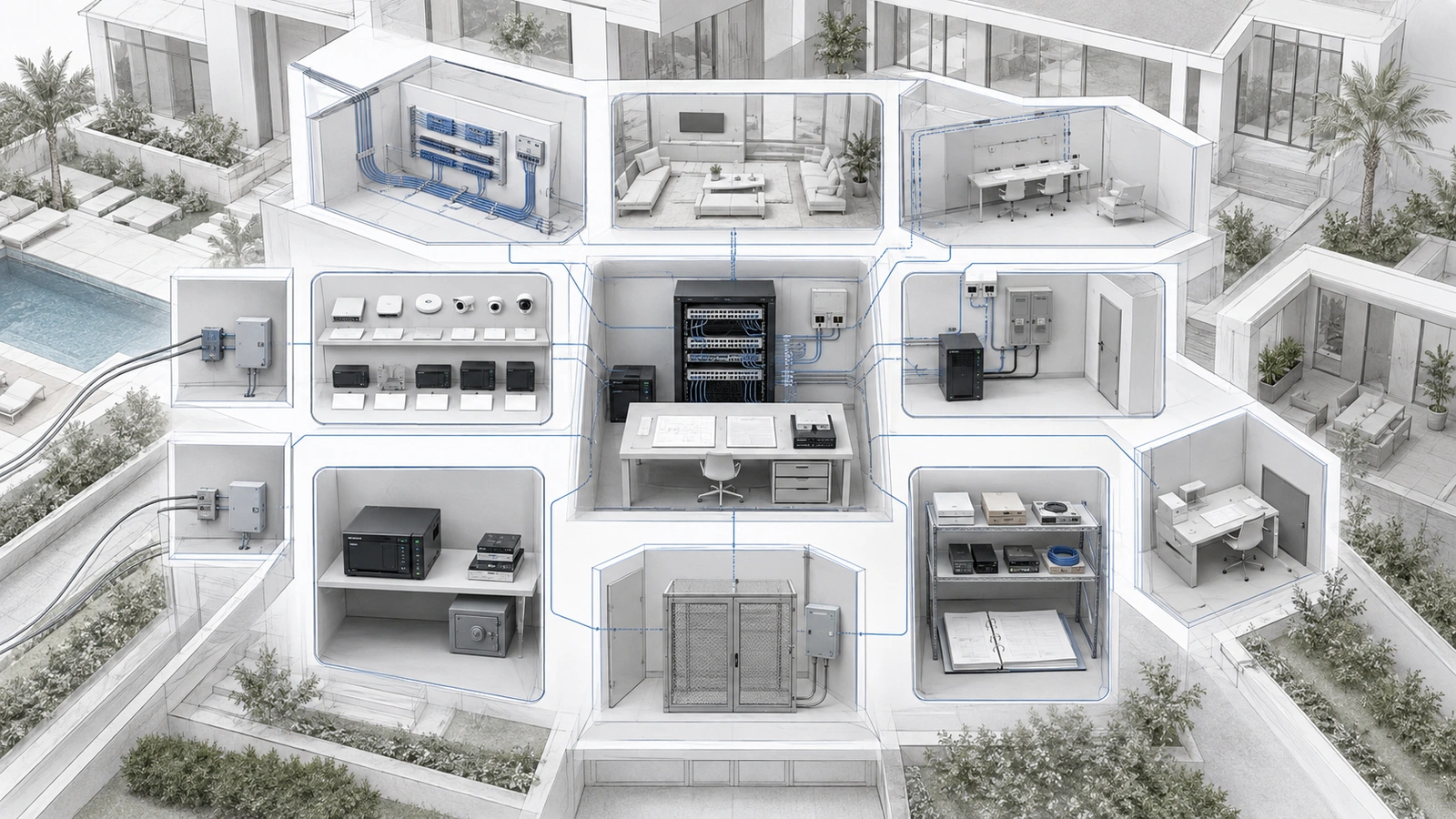
Different records serve different purposes. A physical diagram may show closets, switches, access points, and cable paths. A logical diagram may show network segments, routing relationships, internet connections, and system dependencies. An inventory records models, serial numbers, locations, warranty status, and lifecycle information.
Credentials should not be written directly into ordinary diagrams or widely shared spreadsheets. They belong in an approved, access-controlled credential vault with defined ownership and recovery procedures.
03 The Costs Usually Remain Hidden Until Something Changes
An undocumented network may appear inexpensive because its costs are deferred. The property does not see a documentation line item, but it repeatedly pays for technicians to reconstruct missing knowledge.
| Missing Record | Immediate Consequence | Long-Term Cost |
|---|---|---|
| Network diagram | Technicians must trace connections manually | Longer outages and repeated discovery labor |
| Equipment inventory | Unknown models, ages, locations, and ownership | Weak budgeting and unexpected replacement needs |
| Administrative-access record | Authorized teams cannot manage critical systems | Resets, reconfiguration, downtime, or vendor dependency |
| Change history | Recent modifications cannot be correlated with failures | Slower diagnosis and recurring problems |
| Configuration backups | Failed equipment cannot be restored quickly | Rebuilding systems from memory or from scratch |
| Dependency map | Teams cannot predict downstream effects | Maintenance work causes avoidable service disruption |
These costs appear as extra site visits, emergency labor, longer project schedules, duplicate cabling, unnecessary equipment replacement, and operational disruption.
The property may pay to rediscover the same information several times because the results of each investigation were never returned to an authoritative record.
04 Missing Access Is Different From Secure Access
One of the most disruptive documentation failures is the loss of administrative control.
Properties may discover that a router uses unknown credentials, a camera platform belongs to a former employee, a cloud subscription is registered to a vendor’s email address, or an internet account cannot be accessed by the current management team.
The correct solution is not to place every password in a shared document. That replaces an availability problem with a security problem.
A mature access model separates operational information from authentication secrets:
- Diagrams identify systems and responsible parties without displaying passwords.
- An approved credential vault stores administrative credentials securely.
- Access is limited according to role and operational need.
- Recovery procedures are available if the primary administrator is unavailable.
- Multifactor-authentication ownership and recovery methods are documented.
- Access is reviewed when employees, board members, or vendors change.
The property should retain administrative ownership even when a qualified vendor performs daily management. Vendors may receive controlled access, but the property should not become dependent on a single outside identity for ownership of its infrastructure.
05 Outages Become Discovery Projects
During an outage, responders need to establish scope, dependencies, and a safe recovery path quickly. An undocumented environment forces them to investigate those fundamentals while services are already unavailable.
If a switch fails, the support team may not know whether it serves cameras, access points, phones, gates, intercoms, or building controls. If the firewall becomes unavailable, responders may not know which remote services, network segments, or failover connections depend on it.
The resulting questions consume recovery time:
- Which systems are affected?
- What was connected to the failed device?
- Is a current configuration backup available?
- Can the replacement support the same configuration and power requirements?
- What must remain isolated during recovery?
- Who is authorized to approve changes?
Documentation cannot guarantee uninterrupted service, but it can allow responders to begin with known facts instead of guesses. That distinction becomes especially important when internet access, surveillance, gates, staff communications, or resident-facing services are affected simultaneously.
After the incident, temporary changes and discovered dependencies should be incorporated into the official record. Otherwise, the next outage begins with the same uncertainty.
06 Undocumented Knowledge Creates Vendor Lock-In
A property can become locked into a vendor even without a restrictive contract. The dependency exists because the vendor is the only party that understands the environment.
Warning signs include:
- Only one technician knows how the system is connected
- Administrative accounts are controlled by a vendor
- No current diagrams or inventories have been delivered
- Configuration backups are unavailable to the property
- License renewals and cloud services are tied to outside identities
- No formal offboarding or knowledge-transfer process exists
This weakens the property’s ability to compare service providers, negotiate support arrangements, or change vendors without disruption.
A professional vendor relationship should make the environment more understandable over time. Relevant diagrams, inventories, approved backups, account ownership, and change records should remain available to the property according to the support agreement.
For a deeper examination of this issue, see Vendor Lock-In Problems in Residential Infrastructure.
07 Unknown Infrastructure Is Also a Security Problem
Security teams cannot consistently protect assets they do not know exist.
An unidentified device may remain connected for years without firmware review, password rotation, monitoring, lifecycle planning, or confirmation that it is still required. Former vendors may retain remote access. Old port-forwarding rules or cloud integrations may remain active after the associated project has ended.
Documentation should help authorized reviewers identify:
- Internet-facing systems and remote-access paths
- Active network equipment and connected infrastructure
- Administrative owners and approved vendors
- Network segments and important trust boundaries
- Software, firmware, license, and support status
- Systems approaching end of support
- Configuration-backup and recovery locations
Sensitive documentation requires its own protection. Detailed diagrams, IP information, account records, and recovery procedures should be access-controlled, backed up securely, and shared only with people who need them.
Many properties also benefit from maintaining two views: a confidential operational record for authorized technical personnel and a sanitized overview for boards, management, budgeting, and vendor coordination.
08 Build a Documentation System Proportional to the Property
Good documentation does not require unnecessary bureaucracy. A private residence and a multi-building association need different levels of detail, but both benefit from an accurate minimum record.
A practical documentation set may include:
- A physical network and equipment-location diagram
- A logical diagram showing internet, network segments, and critical dependencies
- An equipment inventory with model, serial number, location, role, and lifecycle status
- Switch-port, patch-panel, and important cable labels
- Internet circuit, provider, account, and support information
- Power, UPS, generator, and environmental dependencies
- Vendor contacts, contracts, licenses, and support responsibilities
- Secure administrative-access ownership and recovery procedures
- Approved configuration backups and restoration instructions
- Remote-access methods and authorization records
- Change history, review dates, and document ownership
- Basic outage and recovery runbooks for critical services
The system should identify one authoritative location rather than allowing uncontrolled copies to spread across personal inboxes, laptops, and vendor folders.
Each document should show an owner, a last-reviewed date, and enough version information to determine whether it can be trusted.
09 Maintain and Test the Record
Documentation that no longer reflects the environment can mislead responders and, in some cases, create more risk than having no diagram at all.
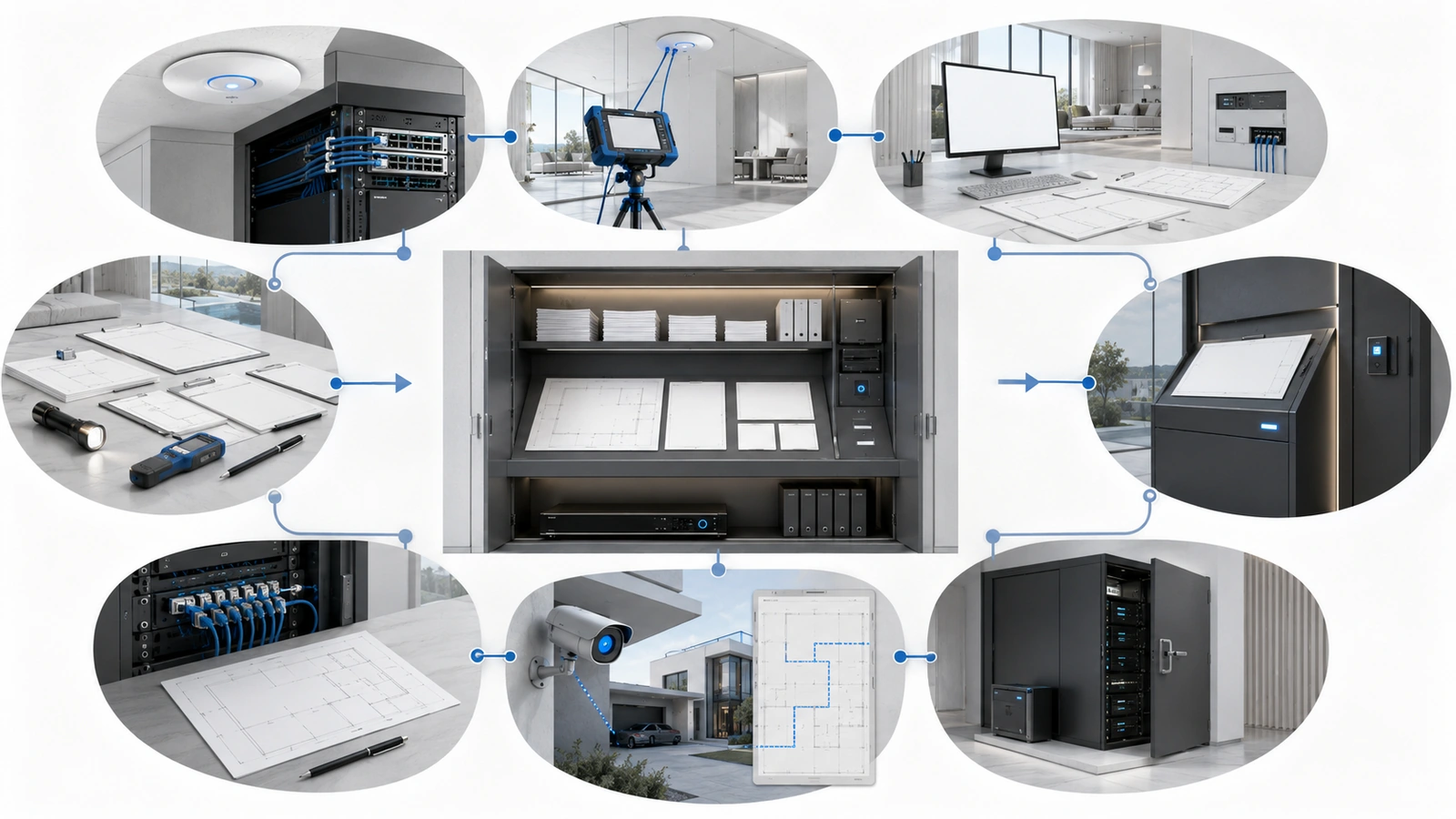
Records should be updated as part of the work—not months after the project is considered complete. Installation, replacement, emergency repair, vendor transition, and configuration change procedures should all include documentation closure.
Minimum Documentation Review Checklist
- Confirm that diagrams match the current physical and logical environment.
- Reconcile the inventory with equipment actually installed.
- Verify labels on critical cables, switch ports, racks, and power connections.
- Confirm property ownership of essential accounts and subscriptions.
- Review current vendor and former-vendor access.
- Test approved credential-recovery procedures.
- Confirm that configuration backups are current, encrypted, and recoverable.
- Record temporary changes made during recent incidents.
- Review lifecycle, warranty, licensing, and support dates.
- Assign the next review date and responsible owner.
Important records should also be available when the primary network or cloud platform is unavailable. A recovery plan that can only be reached through the failed system may not be useful during an actual outage.
This does not mean leaving sensitive information unprotected. It means designing secure, controlled access with appropriate backup and recovery paths.
Final Perspective
The real cost of an undocumented network is not the missing diagram itself. It is the uncertainty introduced into every decision that follows.
Outages last longer because dependencies must be discovered. Upgrades cost more because existing conditions must be reconstructed. Security reviews miss assets that nobody recorded. Vendor transitions become difficult because knowledge and access never remained under property control.
These are recurring infrastructure patterns across private homes, associations, hospitality environments, and shared residential properties. The scale changes, but the operational lesson remains consistent.
Documentation does not need to be excessive, and it will not eliminate every failure. It must be accurate, appropriately protected, proportional to the environment, and incorporated into normal technical work.
When that happens, the property stops depending on memory and begins operating from reliable institutional knowledge.