
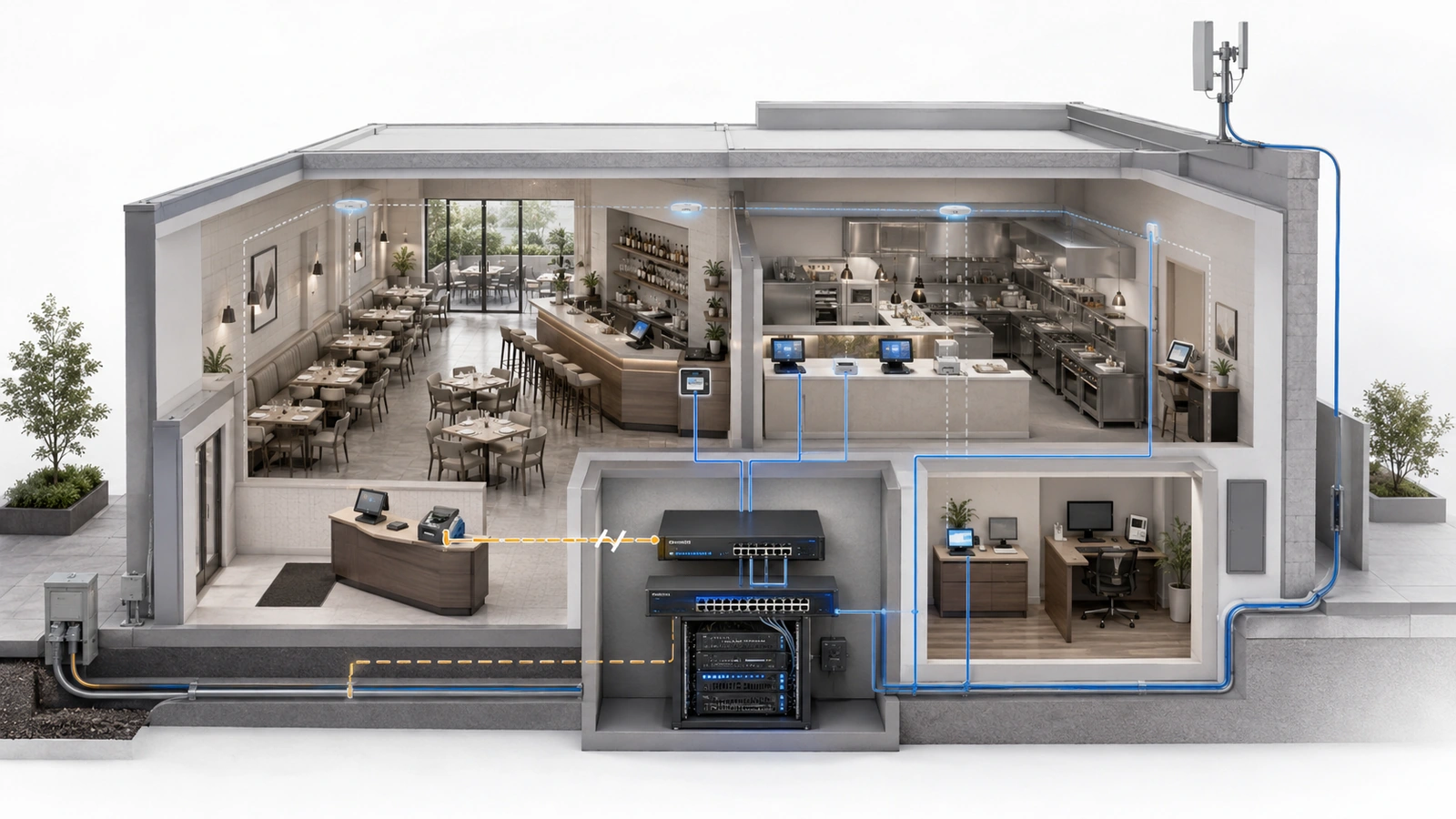
Restaurants and hospitality properties increasingly depend on internet connectivity for payments, POS synchronization, online ordering, reservations, cloud management, guest access, entertainment, and remote support.
When the primary connection fails, several workflows may be affected simultaneously. A backup connection can reduce that disruption, but only when the property understands which services must continue, how the network changes paths, and what limitations apply during degraded operation.
Effective failover is therefore not simply a second modem. It is a coordinated continuity design involving diverse connectivity, gateway configuration, traffic policy, power protection, application behavior, monitoring, staff procedures, and recurring testing.
The POS-specific dependencies behind this planning are covered in POS Network Design: Stability First, Speed Second.
Key Takeaway
Failover should preserve the property’s most important operational functions—not attempt to reproduce every normal service without limitation. Critical traffic, backup capacity, application behavior, and staff expectations must be defined before an outage occurs.
01 Identify What Actually Depends on the Internet
The first step is to map the services that require external connectivity. Some workflows may continue locally, while others depend completely on outside platforms.
Internet-dependent services may include:
- Payment authorization
- Cloud-based POS functionality and synchronization
- Online ordering and delivery integrations
- Reservation, membership, or property-management platforms
- Cloud-managed kitchen or inventory systems
- VoIP and cloud communications
- Guest Wi-Fi
- Streaming television and audio services
- Remote surveillance viewing
- Vendor administration and monitoring
The team should classify each service according to operational importance:
- Critical: Needed to continue essential business workflows
- Important: Operationally valuable but temporarily manageable
- Nonessential during failover: Can be limited or disabled until normal service returns
That classification should be based on business impact rather than data usage alone. A low-bandwidth payment connection may be more important than several high-bandwidth streaming televisions.
The property should also verify what each platform does without internet access. Offline capability, queued transactions, local printing, synchronization, and payment restrictions vary by vendor and configuration.
02 Understand What Automatic Failover Does
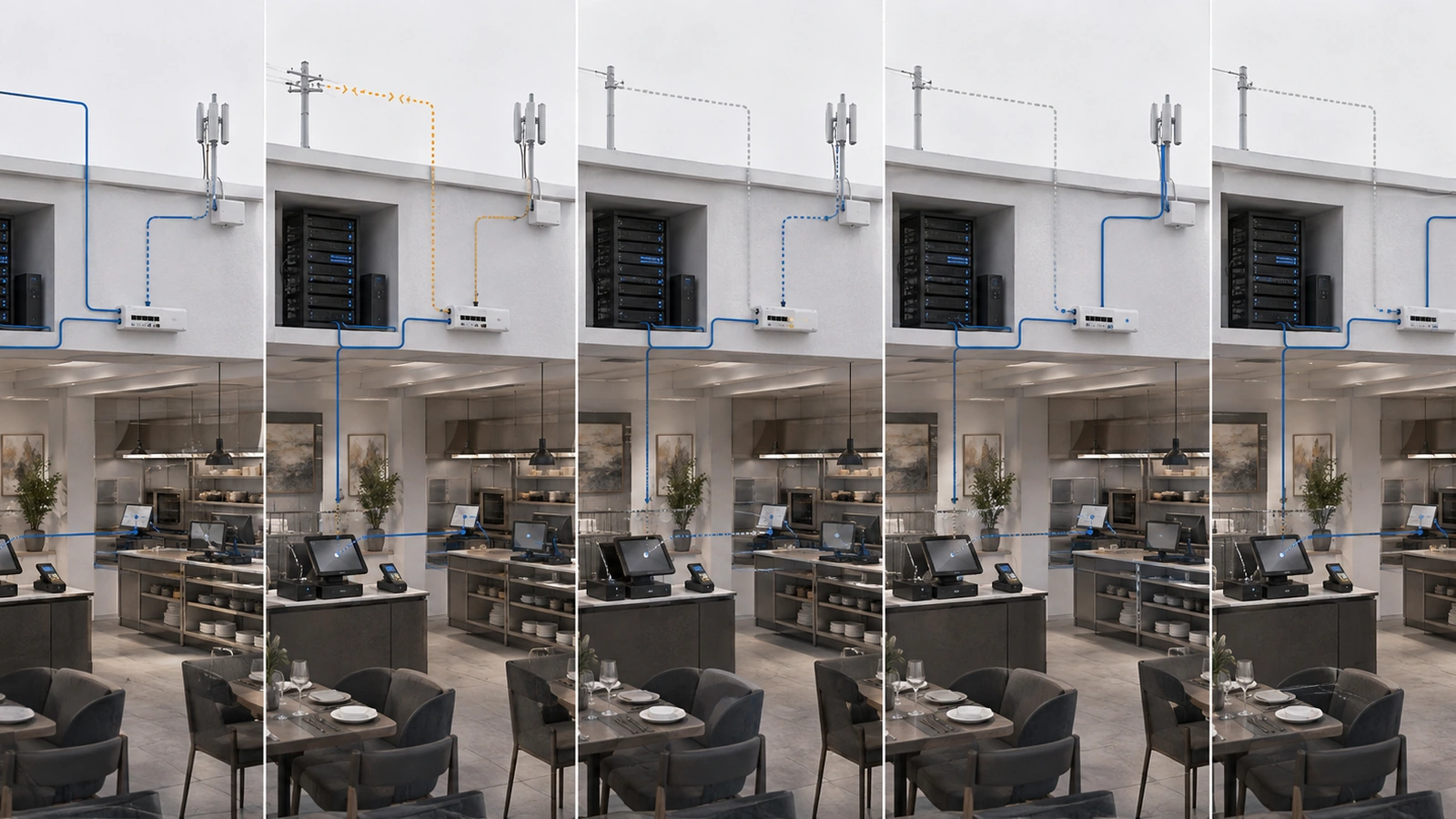
A dual-WAN gateway or similar system monitors the primary connection and changes traffic to a secondary path when defined failure conditions are met.
The process generally includes:
- The gateway detects that the primary connection is no longer usable.
- New traffic is directed through the backup connection.
- Applications and devices reconnect as necessary.
- The gateway continues monitoring the primary service.
- Traffic returns according to the configured restoration policy.
This process is not always seamless. Detection takes time, and existing sessions may be tied to the previous public address or network path. Payment terminals, voice calls, remote-access sessions, streams, and cloud applications may need to reconnect.
A connection can also fail partially. The physical link may remain active while DNS, routing, upstream connectivity, or a required destination becomes unavailable. Effective health monitoring should test useful external reachability rather than relying only on whether the modem’s Ethernet port remains connected.
Failover sensitivity requires balance. Detection that is too slow extends an outage. Detection that is too aggressive may switch connections during a brief fluctuation and create unnecessary disruption.
03 Compare Backup Connectivity Options
The appropriate secondary connection depends on service availability, business impact, budget, building conditions, and the capacity required during degraded operation.
| Backup Option | Potential Advantage | Important Limitation |
|---|---|---|
| Secondary wired provider | Can provide substantial capacity and support more normal services during an outage | May share conduits, utility infrastructure, or upstream facilities with the primary provider |
| Cellular LTE or 5G | Can avoid the building’s wired carrier entrance and is often practical to deploy | Performance depends on signal, tower load, carrier availability, data policy, and antenna placement |
| Fixed wireless service | May provide a physically different local access path | Requires suitable signal path, mounting, power, provider coverage, and weather-aware installation |
| Secondary service from the same provider | May simplify billing and support | Could share the same provider systems and failure domain as the primary connection |
A smaller restaurant may use cellular backup to preserve POS, payments, reservations, and management access. A resort, club, or larger venue may require a secondary wired circuit capable of supporting a broader set of services.
The goal is not automatically to match the primary connection’s maximum speed. It is to support the services designated for continuity with sufficient capacity and acceptable performance.
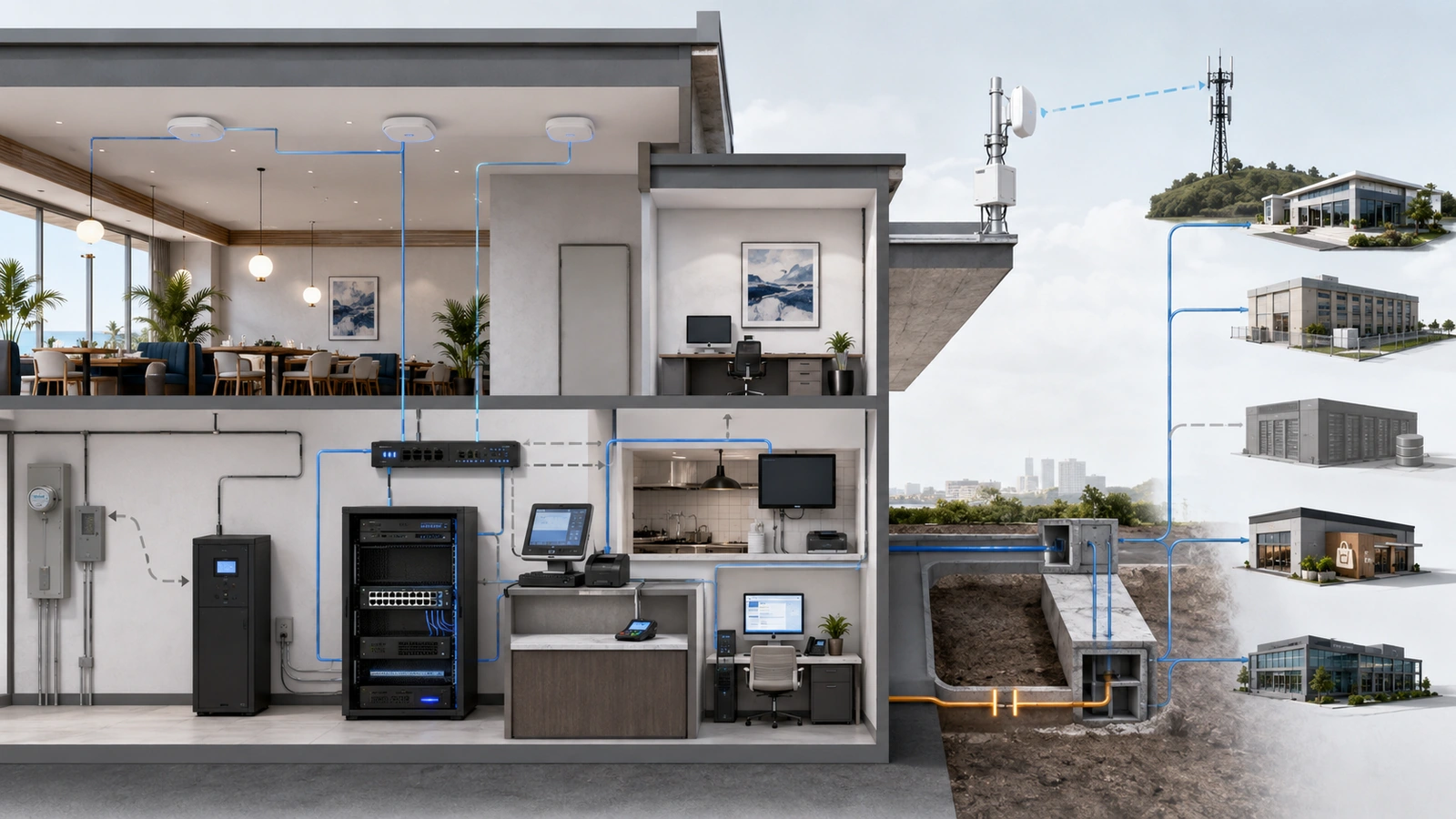
04 Verify Real Provider and Path Diversity
Purchasing connections from two companies can reduce provider-specific risk, but different provider names do not prove that the services are physically independent.
Connections may still share:
- The same building entrance
- A common underground conduit
- The same utility pole or local route
- A common telecommunications room
- Shared electrical infrastructure
- Wholesale carrier or upstream facilities
True diversity may involve different building entrances, physically separated outside routes, different access technologies, separate provider networks, or combinations of these protections.
Complete diversity is not economically justified for every business. The decision should reflect outage cost and operational tolerance. What matters is understanding which failure scenarios the backup design addresses.
A cellular backup may avoid a damaged local cable while still depending on commercial power and regional carrier infrastructure. A second wired connection may provide greater capacity while remaining vulnerable to a shared conduit cut.
The continuity plan should describe those limitations honestly so management understands the protection being purchased.
05 Engineer Cellular Backup for the Installed Location
Cellular backup is attractive because it can use infrastructure outside the primary wired path. Its performance should never be assumed from a phone’s signal indicator alone.
Evaluation should include:
- Signal quality at the intended gateway or antenna location
- Performance from more than one suitable carrier where practical
- Behavior during busy local periods
- Building materials that weaken indoor service
- External-antenna requirements and cable limitations
- Weatherproofing, mounting, grounding, and surge considerations
- Data allowances, throttling, and overage policies
- Carrier addressing and inbound-connectivity limitations
- Gateway compatibility and management visibility
Placement matters. A gateway inside a metal rack, interior closet, kitchen area, or shielded equipment room may receive substantially worse service than equipment or an antenna positioned appropriately.
Cellular capacity can also change during a wider outage. When many nearby businesses and residents switch to mobile connectivity simultaneously, the serving network may become more congested.
The property should test the actual installed system with the intended applications rather than relying exclusively on a coverage map or one daytime speed test.
Cellular Backup Is a Variable Service
A strong test result at installation does not guarantee identical performance during a regional outage or crowded event. Traffic priorities and degraded-operation procedures should assume that backup capacity may be limited.
06 Protect Critical Traffic During Failover
A backup circuit—especially cellular—may have less capacity than the primary service. The network should decide deliberately which traffic continues during failover.
Critical access may include:
- Approved POS and payment services
- Order and kitchen communication requiring external access
- Reservation and essential management platforms
- Business communications
- Required monitoring or security services
Services that may be restricted include:
- Guest Wi-Fi
- Entertainment streaming
- Large software updates
- Nonessential cloud backups
- Public digital-media downloads
Logical segmentation helps identify and control service groups, but segmentation by itself does not prioritize bandwidth. The gateway must apply an appropriate traffic policy, restrict selected networks, or prevent nonessential applications from consuming the backup connection.
The policy should not be so complicated that staff cannot understand degraded operation. A clear plan—critical systems remain available while guest and entertainment services are temporarily limited—is often more supportable than many fragile exceptions.
07 Include Power and Local Infrastructure
Backup internet cannot protect operations if the equipment required to use it loses power.
The complete connection path may include:
- Primary and backup service terminals
- Cellular gateway or external antenna equipment
- Firewall or dual-WAN gateway
- Core and access switches
- Wireless access points
- POS terminals and payment devices
- Kitchen systems
- DNS, addressing, or local controller services
Backup-power planning should calculate the intended runtime and actual load. Batteries require testing, monitoring, and eventual replacement. Equipment should be connected to the correct protected circuits, and the team should verify what happens during generator transfer if a generator is available.
Environmental and physical dependencies matter as well. Water intrusion, heat, cable damage, an unplugged power adapter, or a failed switch can interrupt both internet paths if they converge on the same local equipment.
Failover should therefore be integrated with the property’s complete infrastructure plan, not installed as an isolated accessory.
08 Understand What Failover Cannot Fix
A working backup connection does not make every internet-dependent service available.
Failover cannot independently resolve:
- An outage at the POS provider
- A payment-processor incident
- A failed reservation or ordering platform
- A DNS or identity-service disruption affecting both paths
- A local switch, wireless, cabling, or power failure
- An expired certificate, license, or account
- A configuration error affecting both connections
- A regional incident affecting the primary and backup services
Some vendors also allow access only from approved public addresses or require persistent sessions. A backup connection can change the property’s public address and network characteristics. Vendor requirements should be confirmed during design and tested before production use.
Offline modes can provide another layer of continuity, but they may have limits on payments, synchronization, menu changes, integrations, or reporting. Staff should know which functions are available and how reconciliation occurs after service returns.
The best continuity plan combines connectivity failover, locally resilient workflows where supported, protected power, vendor escalation, and clear manual procedures.
09 Test Failover and Controlled Restoration
A backup service that has never been tested is an assumption, not a continuity system.
Hospitality Internet Failover Checklist
- Inventory internet-dependent services and classify their priority
- Document primary and backup provider technologies and pathways
- Verify cellular signal, antenna placement, data policy, and installed performance
- Configure useful connection-health monitoring
- Define which networks and applications may use the backup path
- Protect required gateways, switches, access points, and endpoints with appropriate power
- Test POS, payment, ordering, reservation, communications, and management access
- Verify guest, streaming, update, and other nonessential restrictions
- Observe session interruption and application-reconnection behavior
- Test controlled return to the primary service
- Confirm queued data or transactions synchronize correctly
- Document alerts, contacts, staff procedures, results, and corrective actions
Testing should occur during a controlled maintenance period with operational and vendor representatives available. The team should disconnect the primary service in an approved manner, verify the transition, exercise critical applications, and observe restoration.
Returning to the primary connection deserves the same attention as entering failover. Rapid switching between unstable paths can create repeated application interruption. Recovery policies may need to confirm that the primary connection is stable before returning traffic.
Recurring tests can identify expired cellular plans, weak batteries, configuration changes, failed antennas, unsupported equipment, missing vendor requirements, or applications that no longer behave as originally documented.
After a real outage, the property should review what failed, which services continued, how staff responded, how long restoration took, and what should change. That converts an interruption into useful operational evidence.
Failover internet is successful when it reduces business disruption predictably. A second connection becomes valuable only after the property defines critical services, confirms realistic diversity, protects local dependencies, limits nonessential traffic, and tests the full transition and restoration process.
The next article examines another type of peak-period pressure that backup bandwidth alone cannot solve: Why Restaurant Wi-Fi Fails During Busy Hours.