
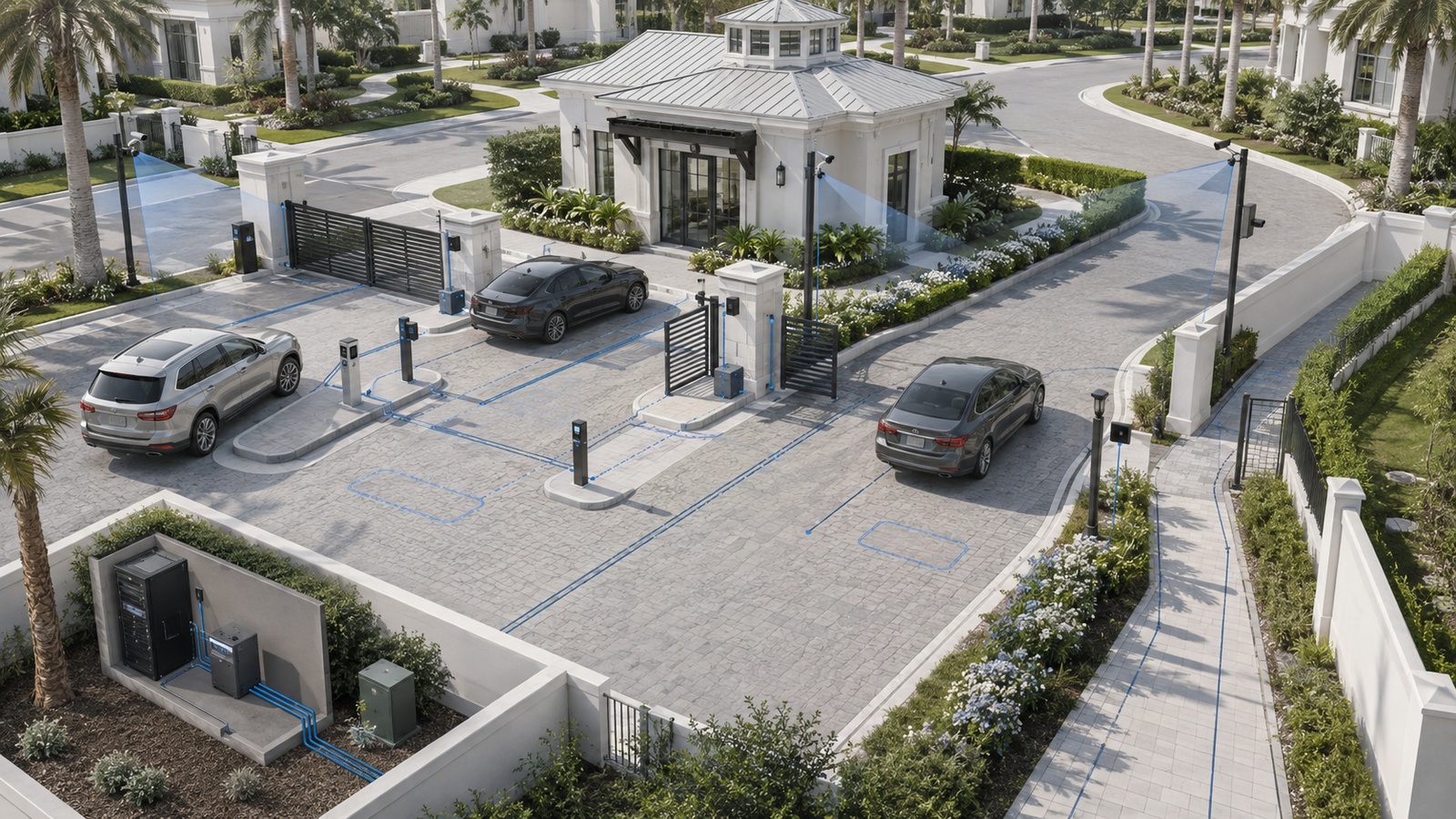
A community entrance is one of the most visible and operationally sensitive systems on a residential property. Residents use it repeatedly, visitors form their first impression there, vendors depend on it to reach scheduled work, and emergency responders may need immediate entry under difficult conditions.
Although people often refer to the entire environment as “the gate,” the physical gate operator is only one component. A modern entrance may also depend on vehicle detectors, credential readers, intercoms, visitor-management software, cameras, network connections, cloud services, safety devices, protected power, and clearly defined operating procedures.
When these elements are planned together, entry can feel secure, predictable, and nearly effortless. When they are assembled independently, the entrance can become a constant source of congestion, resident complaints, intermittent failures, and vendor blame.
Key Takeaway: A smart community entrance is not simply an automated gate. It is a coordinated traffic, access, safety, communications, and operational system.
01 What a Modern Community Entrance Includes
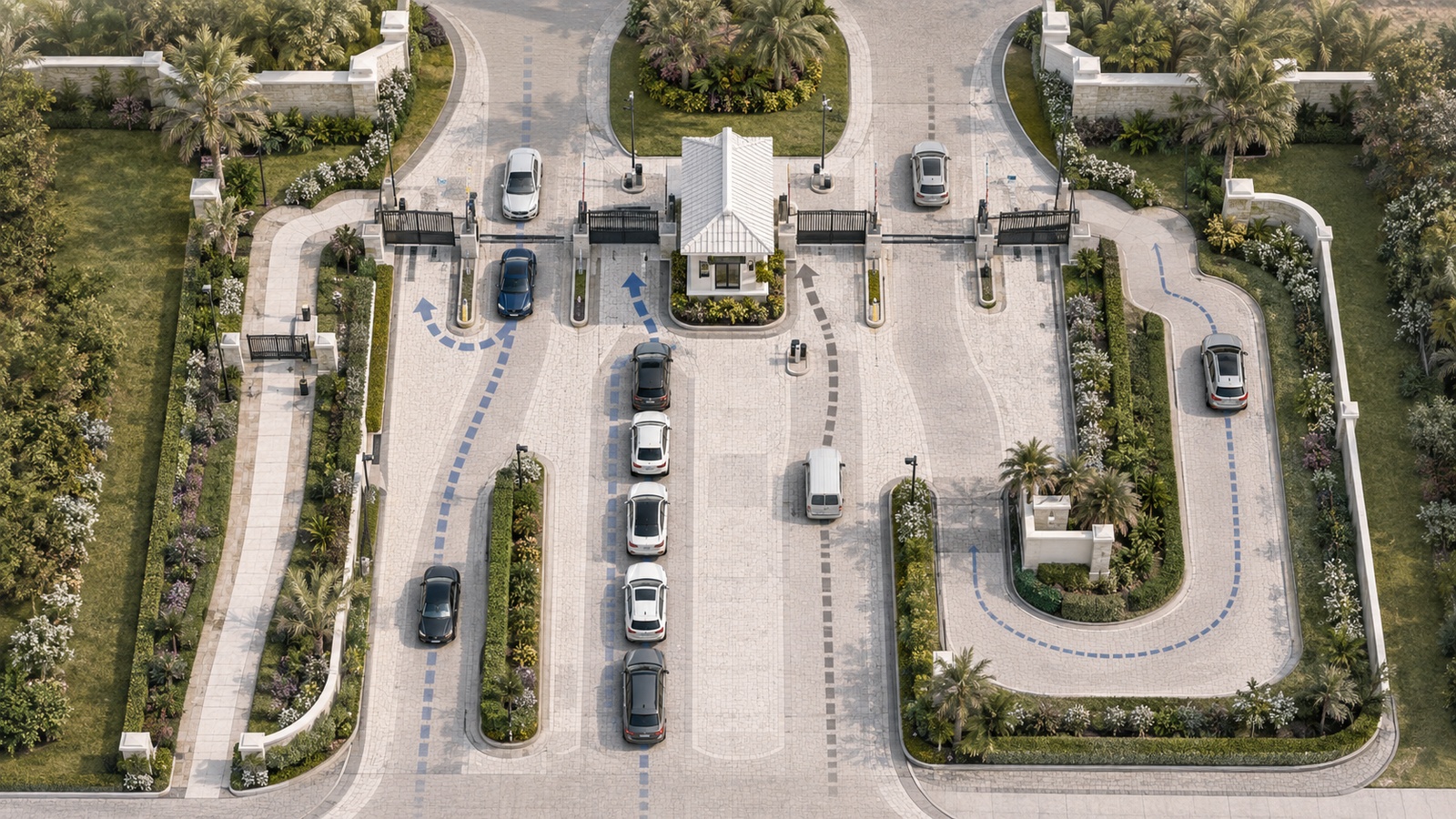
A complete entry environment may support separate vehicle entrances, exit lanes, visitor lanes, pedestrian gates, guard operations, delivery access, service entrances, and emergency routes. Each lane or opening can have different users, risks, and operating requirements.
The technology commonly includes:
- Slide, swing, barrier-arm, or vertical-lift gate operators
- Vehicle loops, presence detectors, and safety sensors
- RFID tags, fobs, mobile credentials, PINs, or license plate recognition
- Video intercoms and resident directories
- Visitor preauthorization and temporary-pass platforms
- Surveillance and event-associated video
- Local access-control panels and gate controllers
- Network, internet, and cellular communications
- Battery backup, surge protection, and emergency controls
- Administrative software, alerts, logs, and support procedures
The entrance must also function as a physical site. Lane geometry, stacking distance, turning radius, drainage, lighting, signage, landscaping, pedestrian movement, equipment placement, and safe technician access can affect performance as much as the software.
A successful design begins by mapping how people and vehicles actually arrive, wait, authenticate, enter, exit, and recover from a denied or failed transaction.
02 Design Around Distinct Entry Workflows
Residents, guests, contractors, deliveries, staff, and emergency responders should not automatically follow the same process. Their frequency, authorization, verification, and support requirements differ.
A resident may need rapid, low-friction entry several times each day. A scheduled contractor may need access only through a service lane during approved hours. A first-time visitor may require resident authorization, while emergency responders need an approved method that does not depend on reaching a resident.
| User Group | Typical Need | Preferred Control |
|---|---|---|
| Residents | Fast, repeatable daily entry | Individual credential with a documented fallback |
| Guests | Simple authorization for a limited visit | Preauthorization, temporary pass, or intercom verification |
| Vendors | Scheduled access to required areas | Named, time-limited credential with restricted permissions |
| Deliveries | High-volume, short-duration entry | Defined delivery workflow without permanent shared codes |
| Staff | Operational access and incident handling | Role-based credential with appropriate administrative separation |
| Emergency services | Reliable entry during urgent or abnormal conditions | Method coordinated with local authorities and applicable requirements |
Special events, holidays, construction projects, resident move-ins, and heavy delivery periods should be considered during design. These conditions can produce traffic volumes far above a normal weekday baseline.
The property should determine what happens after a failed transaction. Drivers need a safe place to pause or leave without reversing into traffic, blocking residents, damaging landscaping, or creating a dangerous queue on a public road.
03 Select Entry Methods Proportionally
Communities often support several credential methods, but each additional method adds administration, equipment, testing, and support responsibilities. The objective is not to offer every available feature. It is to provide dependable options for the property’s real users.
| Entry Method | Primary Strength | Operational Limitation |
|---|---|---|
| RFID vehicle tag | Fast resident entry with minimal interaction | Requires controlled issuance, removal, reader placement, and vehicle records |
| Mobile credential | Convenient remote enrollment and resident use | Needs phone compatibility, onboarding, signal planning, and fallback access |
| License plate recognition | Hands-free entry and useful vehicle-event records | Performance varies with plates, weather, speed, lighting, and camera geometry |
| PIN | Simple temporary or secondary access | Codes can be shared and may remain active longer than intended |
| QR or temporary pass | Defined visitor or vendor access window | Requires clear instructions and appropriate scanning conditions |
| Intercom authorization | Allows real-time visitor verification | Depends on call routing, response time, communications, and user support |
License plate recognition can improve convenience and reduce resident queues, but it should not be treated as perfect identity verification. Dirty, damaged, temporary, decorative, obscured, or newly issued plates can affect recognition. Camera angle, vehicle speed, headlights, rain, shadows, glare, and nighttime illumination also matter.
A well-designed system usually provides a controlled alternative when the preferred method fails. That does not mean maintaining one unrestricted shared code. It means establishing a secondary credential or assisted workflow that preserves accountability.
Credential administration should follow the lifecycle principles described in Access Control Systems for Modern Residential Properties.
04 Visitor Management and Intercoms Shape the Experience
Visitor management is often the difference between a technologically advanced gate and a genuinely efficient entrance. Residents should be able to authorize guests without creating unnecessary work for staff or leaving permanent credentials active.
A practical visitor platform may support:
- Preauthorized guest lists
- Time-limited digital passes
- Recurring but scheduled service providers
- Resident notifications
- Video or audio verification
- Entry history appropriate to the property’s policies
- Immediate credential revocation
Visitor authorization should be understandable before the guest reaches the reader. Confusing directions, hidden scanners, slow directory searches, or multiple unrelated applications can create queues even when every component is technically functioning.
Intercom performance depends on the complete communication path: outdoor station, local network, internet or cellular service, vendor platform, resident phone, application permissions, and gate-trigger response. A delay in any part of that path affects the arrival experience.
Before relying on mobile call forwarding, test it across common phones, carriers, and operating conditions. Determine what happens when residents do not answer, the application is closed, cellular reception is poor, internet service fails, or the cloud platform is unavailable.
Guarded entrances require equally clear workflows. Technology should help attendants verify visitors and find authorizations quickly rather than forcing them to work across several disconnected portals.
05 Vehicle Detection and Gate Safety Are Foundational
Automated gates move heavy physical equipment near vehicles, cyclists, pedestrians, and maintenance personnel. Safety therefore cannot be treated as an optional software feature or postponed until after installation.
Depending on the approved design, the system may use monitored photoelectric sensors, contact edges, vehicle-presence loops, obstruction detection, warning devices, and other protective measures. Detection devices have different purposes. A loop intended to detect a vehicle’s presence, for example, should not automatically be assumed to satisfy every entrapment-protection requirement.
Gate operators, protective devices, controls, and the physical gate assembly should be designed and installed by qualified professionals according to applicable manufacturer instructions, codes, listed-equipment requirements, and recognized standards such as UL 325 and ASTM F2200 where applicable.
The site should also reduce opportunities for pedestrians to enter through vehicle-only lanes. Separate pedestrian access, physical separation, suitable signage, and appropriate gate geometry may be required.
Routine inspection should check:
- Entrapment-protection devices
- Vehicle detection and lane presence
- Gate travel, alignment, and physical condition
- Exposed pinch, crush, or reach-through areas
- Emergency and manual operation
- Warning signs and controlled-area conditions
- Drainage, vegetation, debris, and environmental obstruction
- Unauthorized modifications or bypassed safety devices
Safety Note: Access convenience must never override safe gate operation. Entrapment protection, emergency access, egress, and required inspections should be established before the entrance is placed into service.
06 Cameras and Lighting Must Support the Entry Decision
Entrance cameras serve several purposes: observing approaching vehicles, verifying visitors, reviewing gate events, documenting equipment damage, and assisting with incident investigations. One camera rarely performs every role well.
A complete entrance may require distinct views for:
- Vehicle overview
- Driver or visitor interaction
- License plate capture
- Gate movement and safety area
- Exit activity
- Pedestrian access
Camera placement should be coordinated with lane geometry and lighting. A wide overview camera may show the entire entrance but still provide insufficient detail for a license plate. Conversely, a tightly framed plate camera may not show who interacted with an intercom or what occurred around the gate.
Lighting should provide consistent visibility without creating excessive glare, deep shadows, reflections, or headlight overexposure. Landscape changes must also be considered because growing vegetation can gradually obscure cameras, sensors, wireless paths, and lighting.
Recorded gate events and video can be operationally useful, but access should be restricted according to legitimate job responsibilities. The property should define retention, review, export, and privacy practices instead of allowing unrestricted camera access.
Lighting coordination will be explored in the next guide, Smart Lighting Infrastructure for Shared Residential Properties.
07 Network and Communications Design Determine Reliability
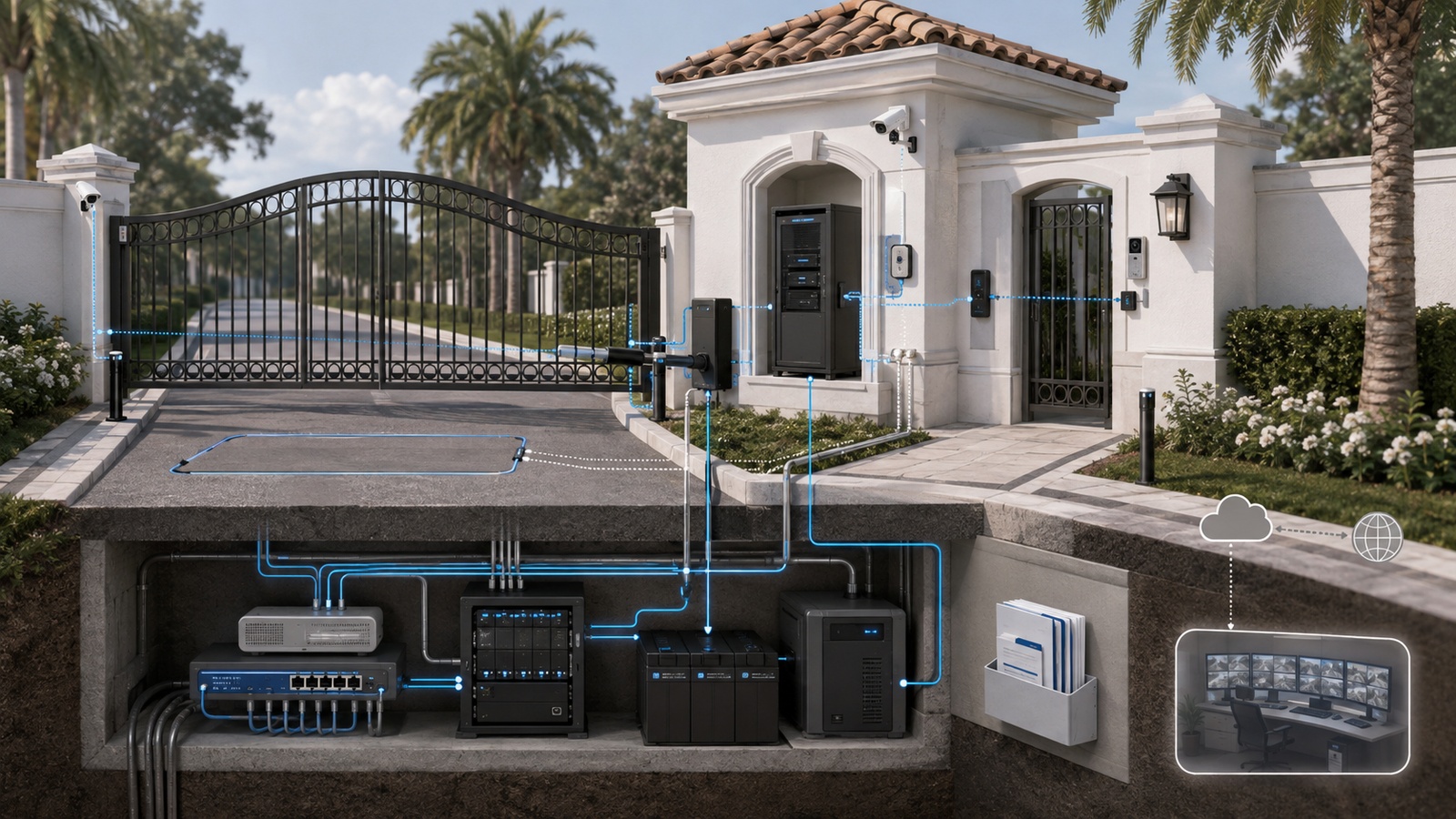
Modern entrances may depend on networking for controllers, readers, intercoms, cameras, license plate systems, management portals, and remote support. Because entrances are frequently distant from the property’s primary equipment room, connectivity must be designed specifically for the site.
Planning considerations include:
- Distance between the entrance and main infrastructure
- Fiber versus copper pathways
- Outdoor-rated cable, conduit, and enclosures
- Electrical isolation and lightning exposure
- Network segmentation and firewall policy
- Switching and Power over Ethernet capacity
- Internet and cellular signal availability
- Local operation during external service failure
- Monitoring and remote-support requirements
Fiber is often appropriate between buildings or distant entrance structures because it supports long distances and avoids some electrical-potential concerns associated with outdoor copper links. The final design depends on site conditions, equipment, pathways, and professional engineering requirements.
Wireless or cellular connectivity may be useful as a primary or secondary path where cabling is impractical, but signal strength alone is not enough. Capacity, latency, interference, carrier coverage, antenna placement, data plans, environmental conditions, and failure behavior must be evaluated.
Gate infrastructure should normally be separated from resident and guest traffic. Firewall policies should allow only required communication, with consistent IPv4 and IPv6 treatment. Administrative portals should use named accounts, multifactor authentication where available, and controlled vendor access.
08 Power and Failure Behavior Must Be Defined
A gate entrance should have documented behavior for utility failure, network interruption, internet loss, cloud-service disruption, controller failure, intercom failure, and severe weather. These conditions do not all require the same response.
Protected infrastructure may include:
- Operator batteries specified for the gate system
- UPS protection for network and communications equipment
- Dedicated circuits
- Appropriate surge and lightning protection
- Generator-supported power where justified
- Supervised power supplies
- Environmental monitoring inside enclosures
- Approved manual and emergency operating methods
Battery capacity should be based on actual load, gate activity, desired runtime, battery condition, and manufacturer guidance—not on an assumed number of hours. Backup systems require periodic testing and eventual replacement.
The property should know whether previously issued resident credentials continue working locally during an internet outage, whether visitors can still contact someone, whether cameras continue recording, and how staff will operate the entrance if remote administration is unavailable.
Emergency responder access and evacuation behavior must be coordinated with local authorities and qualified gate professionals. Staff should not improvise by disabling protective devices or bypassing approved controls during an outage.
09 Commissioning and Operating the Entrance
Acceptance testing should evaluate the complete arrival experience under normal traffic, busy periods, denied access, and infrastructure failures. Confirming that the operator opens and closes is not sufficient.
Smart Gate and Entry Planning Checklist
- Map resident, guest, vendor, delivery, staff, pedestrian, and emergency workflows.
- Verify lane geometry, vehicle stacking, turnaround, drainage, lighting, and technician access.
- Provide appropriate primary and fallback entry methods.
- Use named, limited, and expiring visitor and vendor credentials.
- Coordinate gate operators, controllers, intercoms, cameras, and visitor platforms.
- Have qualified professionals design and test all required safety devices.
- Provide separate and appropriate pedestrian access.
- Test camera views and recognition performance during day, night, rain, and glare.
- Use suitable cabling, fiber, enclosures, grounding, and surge protection.
- Separate gate infrastructure from unrelated network traffic.
- Verify local behavior during network, internet, and cloud outages.
- Test protected power, battery condition, and restoration behavior.
- Document emergency access and manual operating procedures.
- Assign ownership for credentials, alerts, maintenance, and vendor escalation.
- Retest the system after significant software, hardware, or site changes.
Operational records should include equipment and controller inventories, credential methods, gate schedules, visitor procedures, network diagrams, power sources, safety-device tests, configuration backups, vendor contacts, subscriptions, warranties, and change history.
The community should also establish performance indicators that reflect resident experience and system health. These might include gate availability, repeated credential failures, intercom call completion, queue incidents, safety-device faults, and average support resolution time. Metrics should improve operations rather than create unnecessary surveillance or collect data without a defined purpose.
Smart gate systems succeed when the physical entrance, technology, safety design, and operational procedures are treated as one environment. A reliable entrance should be fast for authorized residents, understandable for visitors, controlled for vendors, safe for every user, and recoverable when normal infrastructure becomes unavailable.