
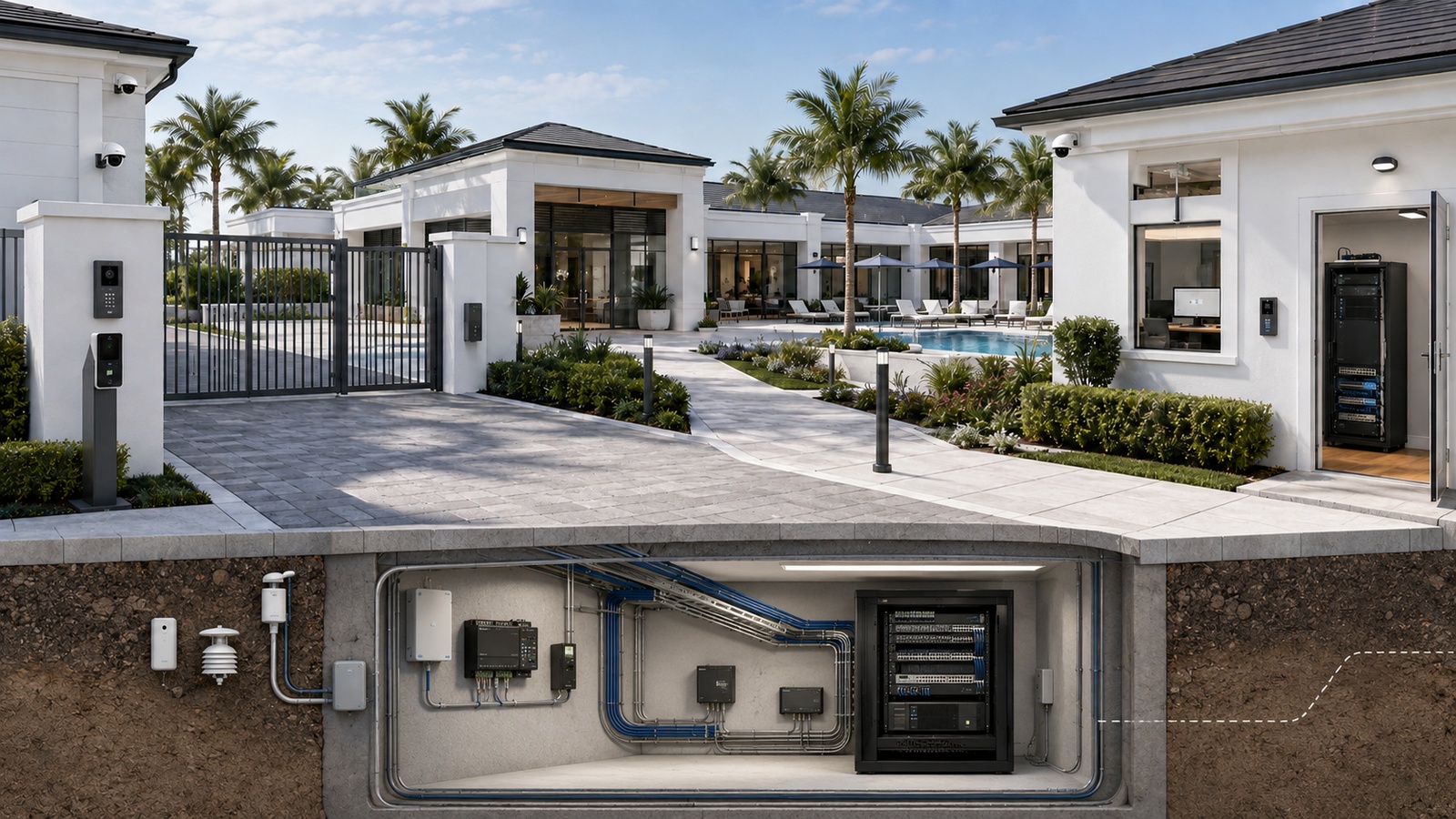
Modern properties increasingly depend on connected technology for entry, surveillance, communications, lighting, environmental awareness, and daily operations. These systems may appear separate to residents, but behind the scenes they rely on many of the same network, power, management, and support resources.
That dependency is what turns a collection of smart devices into property infrastructure.
A mobile credential cannot open a gate reliably without properly designed controllers and communications. A surveillance platform cannot provide dependable remote visibility without stable connectivity, protected power, sufficient storage, and secure administration. Environmental sensors provide little operational value if nobody receives, owns, or acts on their alerts.
The objective is therefore not to install the greatest number of connected products. It is to create a coordinated environment in which each system has a defined purpose, dependable infrastructure, appropriate security boundaries, and a practical operating procedure.
Key Takeaway: A property becomes meaningfully smart when its systems operate as one manageable environment—not merely when it contains many internet-connected devices.
01 What Smart Property Infrastructure Actually Means
Smart property infrastructure is the combination of physical pathways, connectivity, operational systems, management platforms, and procedures that allow a property to monitor, secure, automate, and support its environment.
Depending on the property, that environment may include:
- Structured copper and fiber cabling
- Internet gateways, firewalls, switches, and wireless access points
- Vehicle gates, pedestrian entrances, and door controllers
- Intercom and visitor-management platforms
- Surveillance cameras, recorders, and video-management systems
- Lighting controllers and scheduling platforms
- Environmental, leak, temperature, and power sensors
- Building automation and amenity-control systems
- Remote monitoring and alerting platforms
- Backup power, surge protection, and connectivity redundancy
A device does not become operational infrastructure merely because it connects to an application. It becomes part of the property’s infrastructure when people rely on it for security, access, safety, maintenance, communication, or continuity.
This distinction matters. A disconnected smart thermostat in a private residence may be a convenience. A controller regulating temperature in a shared equipment room is an operational system whose failure could affect network hardware, access control, surveillance, or other critical equipment.
02 The Five Layers of a Connected Property
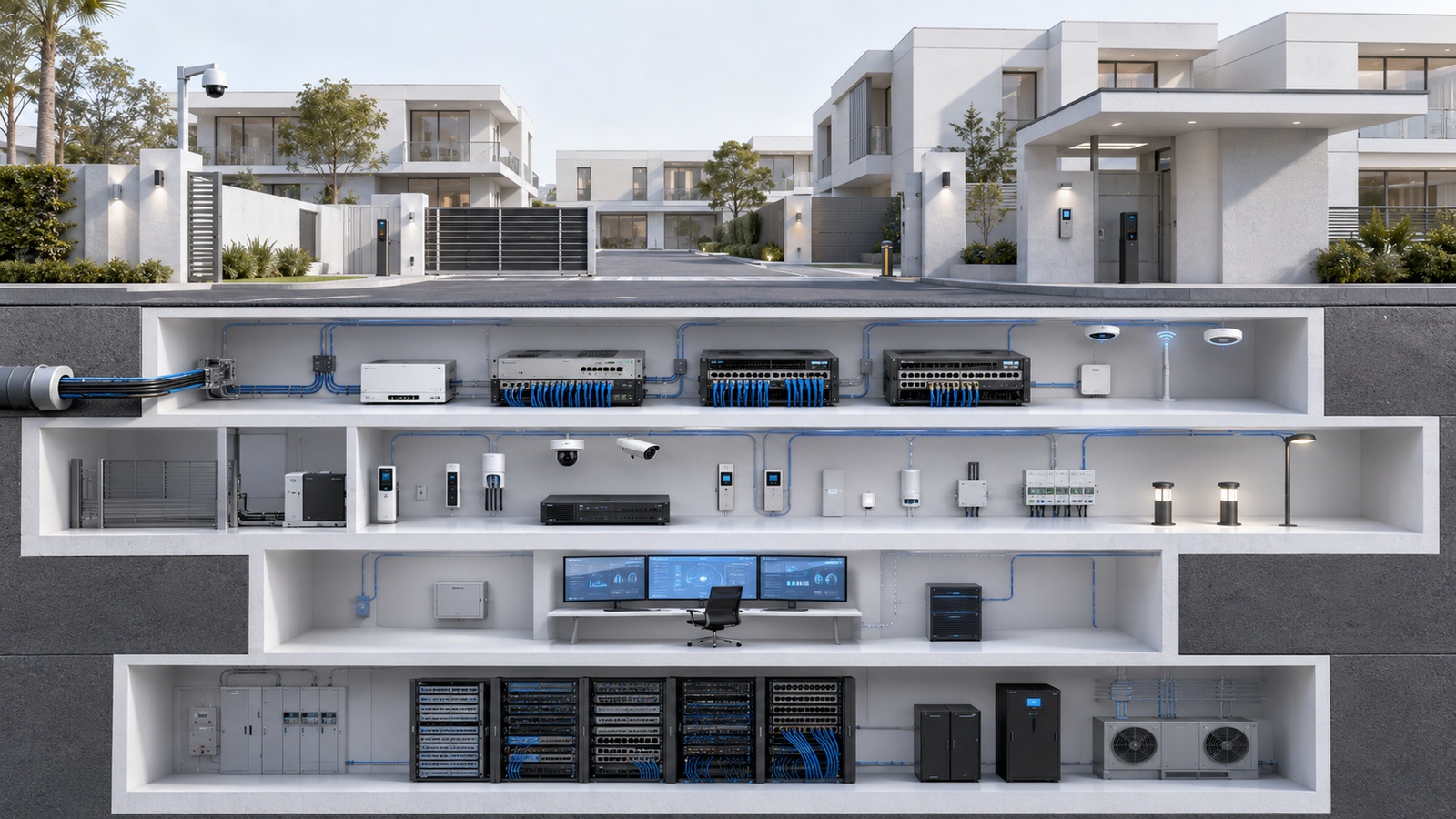
A useful smart-property architecture can be understood as five related layers. Smaller properties may combine several layers in a single device or cabinet, while larger communities may distribute them across buildings, equipment rooms, and outdoor enclosures.
| Layer | Primary Function | Typical Components |
|---|---|---|
| Physical | Provides pathways, mounting, environmental protection, and power | Conduit, cabling, racks, enclosures, circuits, UPS systems |
| Connectivity | Transports data between local systems and external services | Gateways, firewalls, switches, fiber links, access points |
| Property Systems | Performs the actual security, automation, and monitoring functions | Cameras, readers, controllers, sensors, intercoms, lighting |
| Management | Provides administration, alerts, reporting, and remote visibility | Local servers, cloud portals, applications, dashboards |
| Operations | Defines how people manage, maintain, and recover the environment | Ownership, procedures, documentation, testing, vendor support |
Weakness in any layer can affect everything above it. An unreliable fiber link can make a functioning gate controller appear defective. A failed UPS can simultaneously remove switching, cameras, intercom service, and remote monitoring. Missing administrative records can turn a simple personnel transition into a major support problem.
This layered view helps owners and managers diagnose the environment as a system instead of treating every symptom as an isolated device failure.
03 Connectivity Is the Shared Foundation
Most modern property systems depend on network connectivity, even when networking is not visible to residents. Access control panels communicate with management platforms. Cameras send video to local or cloud storage. Intercoms connect visitors with residents. Lighting controllers receive schedules, while environmental sensors deliver alerts.
A professional connectivity foundation commonly includes:
- Documented structured cabling
- Appropriately sized switching capacity
- Power over Ethernet budgets with expansion headroom
- Fiber links between distant buildings or property zones
- Planned indoor and outdoor wireless coverage
- Separate operational networks for different trust levels
- Reliable domain-name, time, and addressing services
- Protected remote administration
- Backup power for essential network paths
- Secondary connectivity where operationally justified
Wireless connectivity should not automatically replace cabling. Fixed cameras, controllers, access points, intercom stations, and other permanent devices generally benefit from wired connections when practical. Wireless links remain valuable where cabling is structurally difficult, but signal strength, interference, capacity, power, and environmental exposure must be evaluated.
Internet connectivity is equally important, but the property should not assume that every essential function can depend entirely on the cloud. Doors, gates, and other critical systems should have defined behavior when internet service is unavailable. Local credentials, controller logic, event buffering, manual overrides, and emergency procedures may all be necessary.
04 Access, Gates, and Visitor Entry Must Be Coordinated
Access control determines who may enter a property, building, room, or amenity. Modern deployments may use mobile credentials, cards, key fobs, PINs, license plates, intercom authorization, or combinations of these methods.
In a private residence, controlled areas might include perimeter gates, garages, service entrances, offices, equipment rooms, and guest accommodations. In a community, the scope may expand to vehicle entrances, pedestrian gates, clubhouses, fitness centers, pools, package rooms, maintenance facilities, elevators, and administrative offices.
Gate and entry systems are especially sensitive because many parties depend on them:
- Residents and household members
- Guests and service providers
- Delivery personnel
- Property employees
- Maintenance contractors
- Emergency responders
A complete design must address more than the reader or gate operator. It should account for credential administration, controller location, safety sensors, intercom communication, surveillance coverage, network paths, power continuity, vehicle loops, manual operation, and failure behavior.
Credential governance is also essential. Properties need a repeatable process for issuing, changing, reviewing, and revoking access. Shared administrator accounts and indefinite vendor credentials make accountability difficult and should be avoided.
For a deeper examination of credentials, controllers, lifecycle management, and door security, continue with Access Control Systems for Modern Residential Properties. Community entrances are covered separately in Designing Smart Gate and Entry Systems for Communities.
05 Surveillance, Lighting, and Monitoring Provide Operational Visibility
Surveillance systems have evolved beyond passive incident recording. Property teams now use video to verify gate activity, review deliveries, observe common areas, investigate alarms, confirm vendor work, and evaluate conditions during storms or after-hours events.
Reliable surveillance depends on much more than camera resolution. The design must consider field of view, mounting height, nighttime conditions, lighting, retention requirements, storage capacity, bandwidth, environmental ratings, surge exposure, account security, and legal or privacy obligations.
Lighting directly influences both property experience and camera performance. Poorly positioned or inconsistent lighting can create glare, deep shadows, overexposure, and reduced incident clarity. Smart scheduling and centralized control can improve consistency, but excessively complicated automation may create unpredictable behavior.
Remote monitoring adds another operational layer by showing whether systems are healthy—not merely whether they were installed. Useful monitoring may include:
- Internet and network availability
- Camera or recorder status
- Gate and door events
- Equipment-room temperature and humidity
- Water leaks and flood conditions
- Power interruptions and UPS health
- Generator status
- Lighting-controller availability
- Controller or sensor communication failures
Alerts must be actionable. Every important notification needs an owner, priority, escalation path, and expected response. Sending hundreds of low-value notifications eventually creates alert fatigue and makes significant events easier to overlook.
06 IoT Devices Need Purposeful Security Boundaries
Connected properties may contain thermostats, televisions, audio systems, appliances, lighting controllers, pool equipment, cameras, intercoms, sensors, gate controllers, and numerous vendor-managed devices. These products do not all have the same security capabilities or operational importance.
Placing everything on one unrestricted network may allow unnecessary communication between unrelated systems. It can also make troubleshooting harder and increase the number of pathways available if one device is misconfigured or compromised.
Purposeful segmentation may separate:
- Private or resident devices
- Guest connectivity
- Operational IoT systems
- Surveillance equipment
- Access-control infrastructure
- Administrative and management systems
- Vendor-maintained platforms
A VLAN can provide logical Layer 2 separation, but it does not create security by itself. Routing and firewall policies must enforce the intended boundaries. IPv4 and IPv6 behavior should both be considered, and required services such as controller communication, printing, casting, multicast discovery, time synchronization, and cloud access must be documented.
Practical Principle: Segmentation should reflect meaningful differences in trust, ownership, or operational function. Creating excessive zones without documentation or support capability can make a property less maintainable.
Management interfaces deserve the strongest protection. Use named administrator accounts, multifactor authentication where supported, approved management devices, controlled vendor access, configuration backups, and appropriate activity logging.
The detailed design considerations are covered in IoT Segmentation for Smart Buildings and Shared Infrastructure.
07 Power, Local Resilience, and Failure Behavior Matter
A smart system is only as dependable as its power and failure planning. A brief outage can simultaneously remove internet service, switching, wireless coverage, cameras, intercoms, controllers, and remote visibility if all of them depend on the same unprotected circuit.
Critical infrastructure may require:
- Dedicated electrical circuits
- Appropriately sized UPS systems
- Surge and lightning protection
- Generator-backed circuits
- Environmental monitoring
- Protected outdoor enclosures
- Orderly shutdown or recovery procedures
- Documented battery replacement schedules
Not every connected device needs hours of backup power. Priorities should be based on operational consequences. Network gateways, core switches, access-control panels, essential intercoms, and critical surveillance components may deserve longer runtime than convenience-oriented automation.
The property should also define the expected state of each essential system during a failure. Questions include:
- Will authorized credentials continue working without internet service?
- Can gates and doors be operated safely and manually?
- Will cameras continue recording locally?
- Are events buffered until cloud connectivity returns?
- Who receives outage notifications?
- How will vendors gain approved emergency access?
- Which functions return automatically when power is restored?
These questions expose operational dependencies before a storm, service outage, or emergency forces the property to discover them under pressure.
08 Ownership and Documentation Turn Technology Into Operations
Multiple contractors commonly participate in a smart-property deployment: electricians, network professionals, gate companies, access-control integrators, surveillance installers, automation specialists, software providers, and internet carriers. Each may complete its own scope successfully while the combined environment remains poorly coordinated.
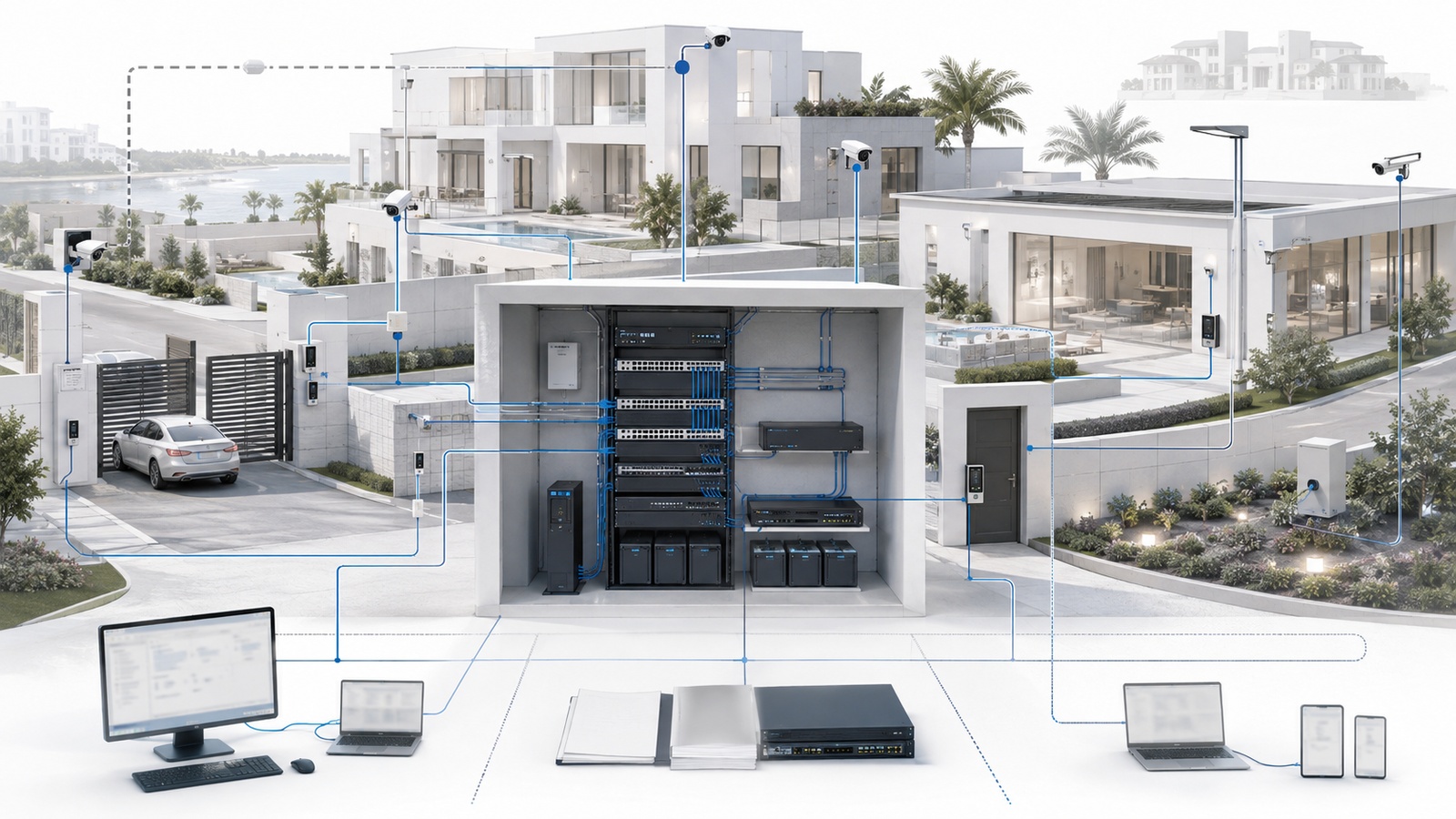
The property therefore needs an internal owner or designated technology coordinator who understands the overall architecture and can direct cross-vendor troubleshooting. That person does not need to personally repair every platform, but must know who owns each system, how dependencies connect, and how support should be escalated.
At minimum, the operational record should include:
- System and device inventory
- Network and physical-pathway diagrams
- Controller and equipment locations
- IP address, VLAN, and dependency records
- Administrative ownership and account-recovery procedures
- Vendor contacts, contracts, and escalation paths
- Warranty and subscription information
- Configuration and controller backups
- Power and internet dependencies
- Maintenance and testing schedules
- Manual operating and emergency procedures
- Change history
Sensitive credentials should be stored in an approved password-management system rather than directly inside broadly accessible diagrams or documents.
Documentation must also be maintained. An accurate diagram from the original installation has limited value after years of undocumented equipment replacements, network changes, and vendor transitions.
09 How to Plan a Smart Property Environment
Planning should begin with operational outcomes rather than product selection. A property should first determine what must be protected, monitored, automated, or made easier to manage.
| Planning Question | Why It Matters | Expected Output |
|---|---|---|
| What problem are we solving? | Prevents technology from being installed only because it appears modern | Defined operational requirement |
| Which systems depend on it? | Reveals connectivity, power, software, and vendor relationships | Dependency map |
| What happens during failure? | Clarifies safety, access, local operation, and recovery requirements | Failure and continuity plan |
| Who operates and supports it? | Prevents abandoned platforms and unclear escalation | Named owner and support workflow |
| How will it grow? | Reduces disruptive cabling, power, storage, and equipment retrofits | Capacity and expansion plan |
Appropriate architecture is proportional to the property. A single residence may need a secure gateway, reliable Wi-Fi, limited segmentation, several cameras, and straightforward automation. A gated community or high-rise may require fiber distribution, multiple equipment rooms, redundant links, centrally administered access, formal monitoring, vendor controls, and documented continuity procedures.
Future-proofing does not mean buying the most expensive equipment or predicting every new technology. It means preserving adaptable pathways, adequate equipment space, power capacity, standards-based connectivity, accessible documentation, and reasonable expansion headroom.
Smart Property Planning Checklist
- Define the operational purpose of every proposed system.
- Inventory existing cabling, connectivity, power, and equipment spaces.
- Map dependencies between gates, doors, cameras, lighting, monitoring, and cloud services.
- Decide which essential functions must continue locally during an internet outage.
- Create purposeful network and administrative security boundaries.
- Protect management accounts and control external vendor access.
- Verify switching, PoE, storage, bandwidth, and electrical capacity.
- Provide backup power according to operational priority.
- Assign internal ownership and vendor escalation responsibilities.
- Document configurations, diagrams, warranties, subscriptions, and recovery procedures.
- Test both normal operation and realistic failure scenarios.
- Review the environment after material changes and at least annually.
Smart property infrastructure works best when it remains understandable, supportable, and resilient. Coordinated systems can improve security, simplify administration, reduce response times, and create a more consistent resident experience. Disconnected products, by contrast, often add complexity without delivering dependable operational value.
The next guide in this category examines one of the most important system families in greater detail: Access Control Systems for Modern Residential Properties.