
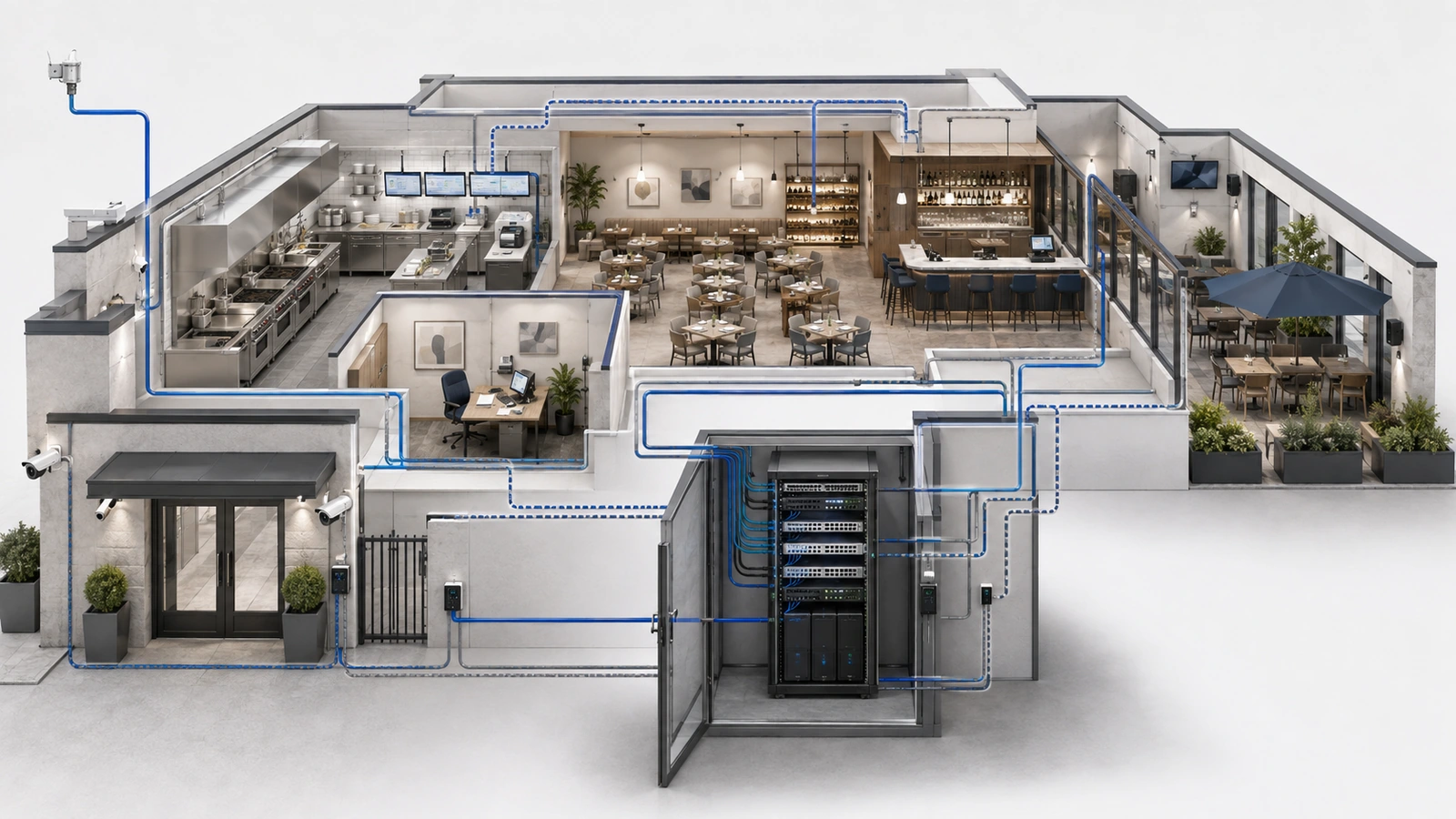
Restaurants and hospitality properties rarely operate with one technology provider. Internet service, POS, payments, kitchen systems, phones, reservations, Wi-Fi, surveillance, access control, audio, televisions, and facility platforms may all come from different companies.
Each vendor is usually responsible for making its own system work. The property, however, depends on those systems operating together across shared pathways, power, network equipment, internet connections, rooms, and administrative processes.
Without coordinated oversight, temporary switches accumulate, wireless networks overlap, remote-access tools remain active, passwords become shared, and infrastructure changes occur without updated documentation. The environment may continue functioning until an outage exposes how little anyone understands about the complete system.
Effective vendor management gives every provider a clear boundary while preserving one authoritative view of the property’s technology environment.
Key Takeaway
The property needs one accountable technical authority with visibility across the complete environment. That authority does not have to supply every system, but it must control standards, approve changes, maintain records, and coordinate incidents.
01 Establish Technical Authority and Ownership
The first governance decision is determining who represents the property’s complete infrastructure interests.
That role may belong to:
- An internal IT or technology leader
- A qualified managed-service provider
- A designated systems integrator
- A property-management representative supported by technical advisors
- A combination of internal and external roles
The authority should maintain visibility into:
- Network topology and service boundaries
- Internet circuits and failover
- Wireless design and approved networks
- Addressing, segmentation, and firewall policy
- Equipment locations and cable pathways
- Administrative and vendor access
- Power and environmental dependencies
- Documentation, configurations, contracts, and licenses
Technical authority should be paired with clearly defined ownership. The company that installed a device may not own it. The property may own cabling while a vendor owns the connected appliance. A provider may administer equipment without being responsible for the room or electrical circuit supporting it.
Ownership, administration, maintenance, replacement, and support should be documented separately where they differ.
02 Define Demarcation and Responsibility Boundaries
Every vendor relationship should identify where responsibility begins and ends. Ambiguous boundaries create delays because several companies can reasonably claim the failure belongs elsewhere.
| Service Area | Vendor May Typically Own | Property Must Still Define |
|---|---|---|
| Internet service | Carrier circuit, provider terminal, and service to the contractual demarcation | Internal gateway, switching, Wi-Fi, power, cabling, failover, and escalation |
| POS and payments | Approved terminals, applications, payment devices, and cloud services | Network path, power, wireless coverage, security boundary, kitchen integration, and local support |
| Kitchen technology | Supported printers, displays, controllers, and routing configuration | Placement, cabling, switching, environmental protection, power, and recovery access |
| Audio and video | Players, processors, amplifiers, displays, control, and content services | Network capacity, segmentation, equipment locations, internet, power, and staff permissions |
| Security systems | Cameras, recorders, access controllers, monitoring, and specialized applications | Approved connectivity, remote access, storage expectations, network boundaries, and room access |
| Managed IT | Agreed network administration, monitoring, support, and documentation | Authority, approval limits, business priorities, vendor coordination, and ownership of records |
The final boundary should be technical and operational. It should identify who responds first, who can make changes, what evidence each party provides, and how unresolved responsibility is escalated.
03 Publish Infrastructure Standards Before Installation
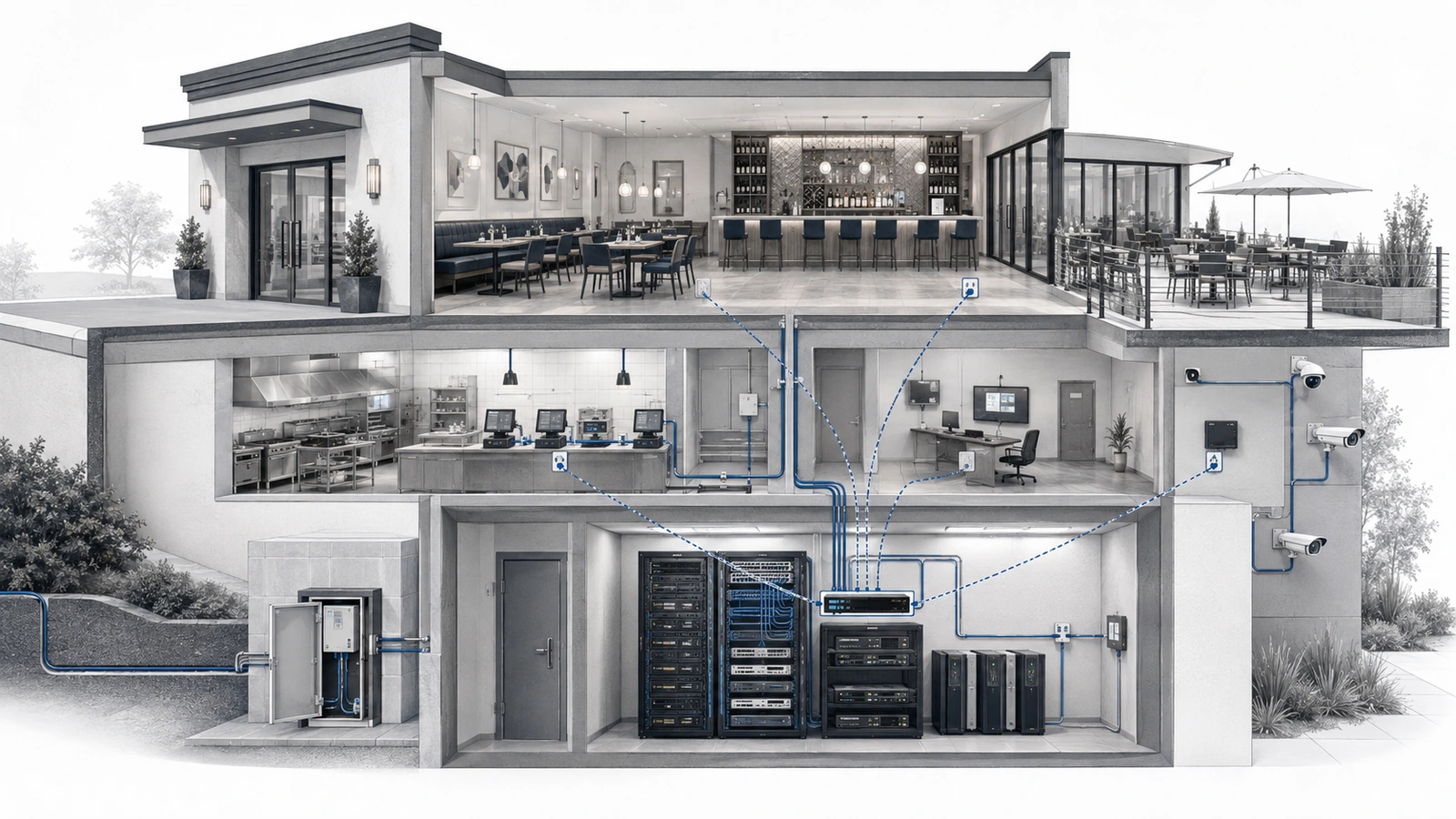
Vendors should receive the property’s technical requirements before equipment arrives. Reviewing requirements after installation often leaves the property choosing between accepting a poor design and paying to rebuild it.
Standards may address:
- Approved cabling and termination practices
- Equipment-room and rack requirements
- Switching and wireless architecture
- Addressing and network-assignment methods
- Required service communication
- Internet and firewall requirements
- Remote-access methods
- Power and environmental protection
- Labeling and documentation
- Testing and acceptance criteria
Before installation, the vendor should provide enough information to evaluate the request. That may include equipment lists, connection types, bandwidth requirements, power, mounting, internet destinations, local communication, discovery behavior, administrative access, and support ownership.
Vendors should not be given unrestricted networks merely because their exact requirements are unknown. The requirement should be clarified and narrowed to what the supported system genuinely needs.
Standardization does not mean every device must come from one manufacturer. It means the environment follows consistent principles for connectivity, security, documentation, management, and serviceability.
04 Control Infrastructure Changes
A change that helps one vendor can disrupt another. Installing a router may introduce an unauthorized addressing service. Adding an unmanaged switch may create a loop or hidden dependency. Changing firewall policy may restore one application while exposing unrelated systems.
Changes requiring review may include:
- Adding or replacing switches, routers, gateways, or access points
- Creating wireless networks
- Changing addressing, DNS, routing, or segmentation
- Adding firewall rules or internet-publishing configurations
- Installing remote-access tools or appliances
- Running new cabling or using existing pathways
- Moving equipment between rooms or circuits
- Adding cloud platforms, subscriptions, or administrative accounts
- Updating firmware or software that may affect integrations
A practical change process should record:
- The business purpose
- The requested technical change
- The affected systems and expected risk
- The authorized implementer and timing
- The backup or rollback method
- The validation result
- The documentation updated afterward
Emergency changes may be necessary during service. They should still be recorded and reviewed after stabilization so temporary workarounds do not become permanent undocumented infrastructure.
Every Temporary Fix Needs an Owner and Exit Plan
An emergency switch, hotspot, cable, firewall exception, or shared credential should have a documented purpose, responsible owner, review date, and removal or replacement plan.
05 Manage Vendor Access as a Lifecycle
Vendors may require on-site or remote access for installation, monitoring, maintenance, and troubleshooting. That access should move through a controlled lifecycle rather than remain open indefinitely.
The lifecycle should include:
- Request: Identify the person, company, system, purpose, and duration.
- Approval: Confirm the business owner and technical authorization.
- Provisioning: Provide an individual account or controlled method with the minimum required access.
- Monitoring: Record important access and changes where appropriate.
- Review: Confirm that continuing access remains necessary.
- Removal: Disable access when work, employment, or the contract ends.
Permanent shared credentials should be avoided. Staff administrative accounts should not be handed to contractors. Remote-access appliances or software should not be connected without review simply because they make support easier for the vendor.
Cloud-connected equipment also creates a remote path even when no traditional remote-access session is visible. The property should understand what data leaves the site, which platform controls the device, who owns the account, and what happens if the subscription or vendor relationship ends.
Physical access matters as well. Equipment-room keys, access cards, lock codes, escorts, and after-hours entry should be issued and removed through controlled procedures.
06 Lead Multi-Vendor Incident Response
During an outage, vendors may naturally focus on evidence supporting their own systems. The POS provider may suspect the network, the ISP may report that its circuit is online, and the network provider may find healthy internal connectivity.
The property needs an incident leader who evaluates the complete service path.
A useful incident record includes:
- Exact start time and affected locations
- Devices, applications, and workflows affected
- Services that remained operational
- Network, power, internet, and platform observations
- Changes made before or during the incident
- Vendor case numbers and assigned contacts
- Temporary workarounds
- Recovery time and confirmed cause
Evidence should replace broad blame. If fixed and wireless POS devices fail while unrelated internet services remain healthy, that narrows the investigation. If several cloud applications fail across wired and wireless devices, the common upstream dependencies deserve attention.
The incident leader should decide which vendor joins first, preserve logs before equipment is restarted where practical, coordinate approved tests, and prevent several vendors from making overlapping changes simultaneously.
After restoration, the property should document the cause, corrective action, remaining risk, and follow-up owner.
07 Maintain Authoritative Documentation
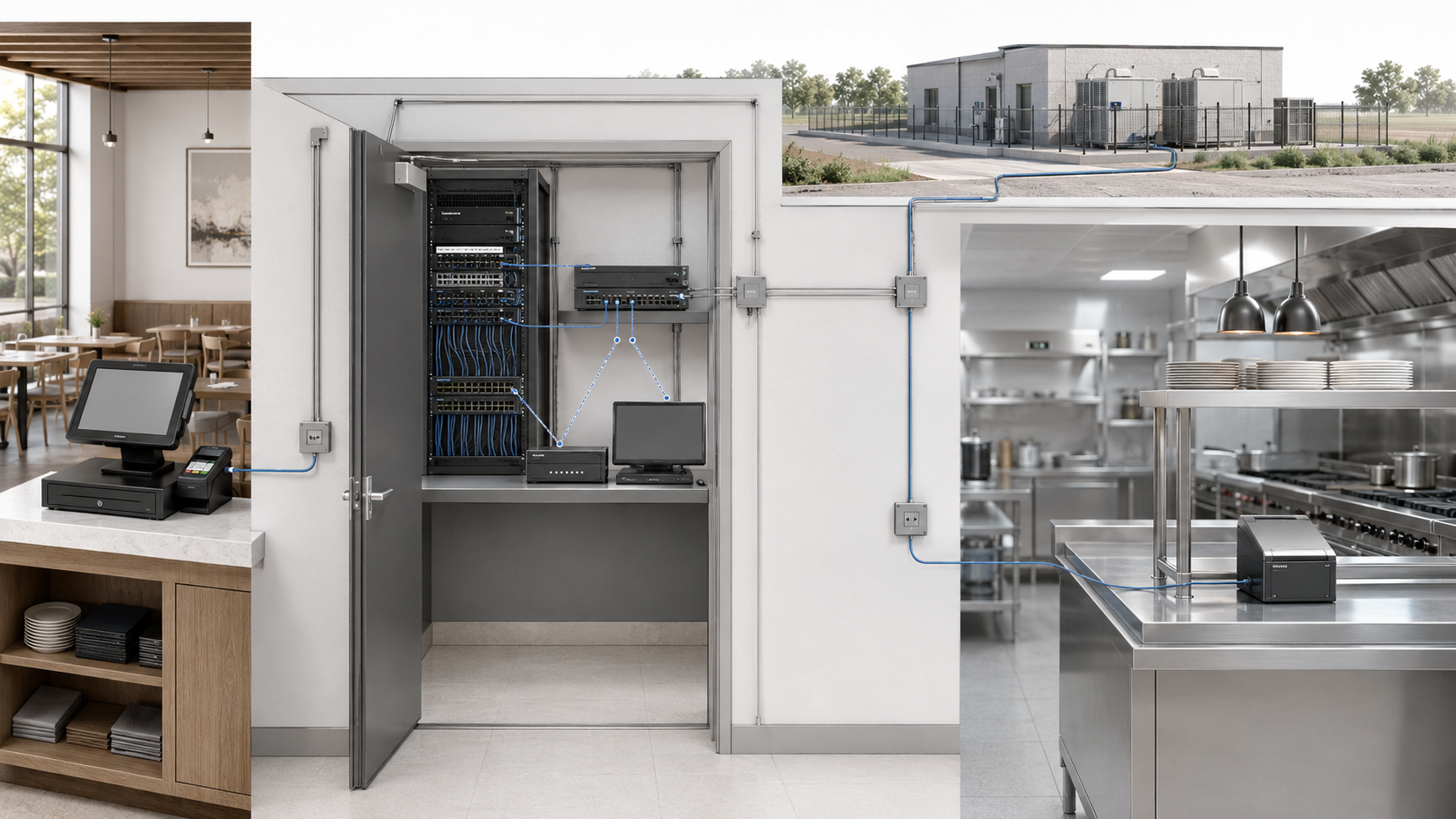
Vendor documentation should become part of the property’s controlled record—not remain solely inside vendor portals, employee inboxes, or the memory of one technician.
The documentation set may include:
- Physical and logical network diagrams
- Internet circuits and service identifiers
- Equipment inventory, locations, serial numbers, and owners
- Rack layouts, switch ports, cable assignments, and pathways
- Network segments, addressing, and approved communication
- Wireless networks and coverage responsibilities
- Vendor contacts, contracts, and escalation procedures
- Licenses, subscriptions, warranties, and renewal dates
- Administrative-account ownership and recovery procedures
- Configuration backups and restoration instructions
- Remote-access methods and approval records
- Change, incident, test, and maintenance histories
Passwords should be stored through an approved secure credential system rather than placed directly inside ordinary diagrams or spreadsheets.
Documentation should identify its owner, last review date, and authoritative version. A diagram created during construction but never updated may be more misleading than no diagram at all.
08 Prepare for Vendor Replacement and Offboarding
The property should be able to replace a vendor without losing control of its infrastructure, accounts, data, configurations, or operating knowledge.
Before entering or renewing an agreement, determine:
- Who owns installed cabling and equipment
- Who owns platform accounts and administrative identities
- Whether configurations and data can be exported
- What documentation must be delivered
- How subscriptions, licenses, and warranties transfer
- How remote access and credentials are removed
- Whether replacement vendors can reuse the infrastructure
- What assistance is provided during transition
- How equipment and data are returned or securely handled
When a vendor relationship ends, the property should:
- Disable individual and shared accounts
- Remove remote-access tools and appliances
- Recover keys, cards, and physical access
- Rotate affected credentials
- Transfer configurations, records, licenses, and warranties
- Remove or reassign abandoned equipment
- Update diagrams and vendor contacts
- Verify that monitoring and backups remain operational
Offboarding should be completed even when the relationship ends amicably. Forgotten access and unsupported equipment create risk regardless of intent.
09 Review the Vendor Environment Regularly
Hospitality infrastructure changes continuously. New services are introduced, outdoor areas expand, subscriptions renew, equipment ages, employees leave, and vendors are acquired or replaced.
Hospitality Technology Vendor Governance Checklist
- Assign one accountable technical authority for the complete environment
- Document ownership, administration, support, and replacement responsibilities
- Define technical and operational demarcation points
- Issue infrastructure standards before vendor installation
- Require approval and records for material changes
- Inventory vendor devices, accounts, cloud services, and remote-access paths
- Review administrative and physical access regularly
- Maintain authoritative diagrams, configurations, contracts, and escalation contacts
- Test incident, failover, backup, and recovery procedures
- Review licenses, warranties, subscriptions, and equipment lifecycle
- Define vendor transition and offboarding requirements
- Remove temporary equipment, exceptions, accounts, and undocumented workarounds
Recurring reviews should look for unknown switches, unauthorized wireless networks, expired accounts, unsupported equipment, abandoned cabling, shared credentials, unmonitored cloud connections, and contracts approaching renewal without technical review.
The goal is not to create paperwork for every routine support action. It is to retain control over changes that affect reliability, security, cost, ownership, or recovery.
Hospitality technology remains manageable when every vendor works within a common operational framework. Clear authority, defined boundaries, controlled access, disciplined changes, useful documentation, and prepared transitions prevent the environment from becoming dependent on fragmented knowledge.
This governance layer completes the category’s technical story. Return to Restaurant & Hospitality Technology Infrastructure: A Practical Foundation for the complete architecture connecting POS, Wi-Fi, kitchens, outdoor systems, entertainment, resilience, and vendor oversight.