
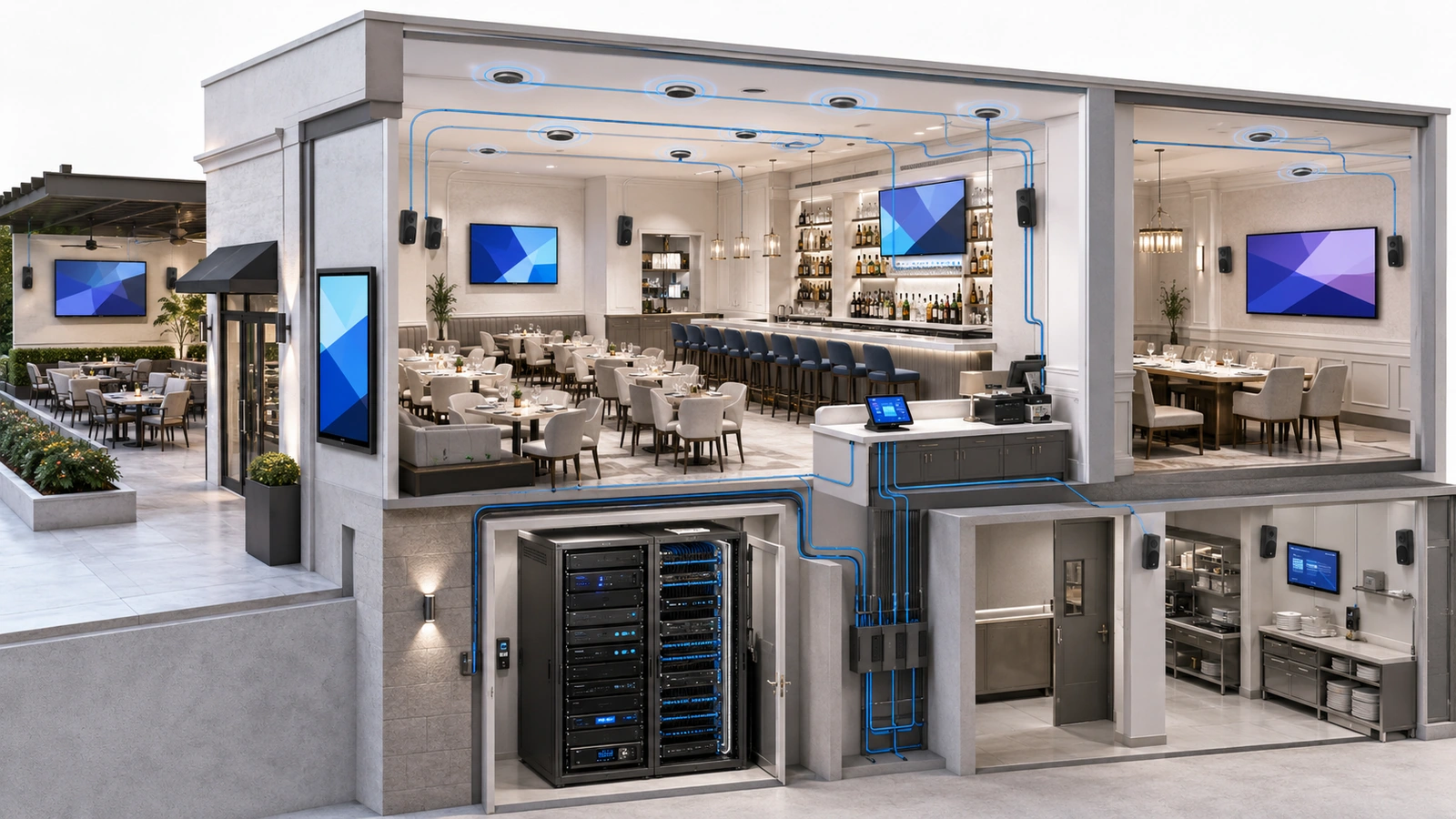
Audio, televisions, streaming platforms, and digital signage shape the atmosphere of restaurants, sports bars, clubs, resorts, and other hospitality spaces. When they operate properly, guests rarely think about the technology behind them. When they fail, the interruption becomes immediately visible or audible.
Modern entertainment systems may depend on internet services, local network distribution, control applications, wireless discovery, audio processors, amplifiers, managed displays, and remote vendor platforms. A television showing a buffering message may therefore represent an ISP problem, a local network issue, a failed player, or an unavailable content service.
Reliable design begins by separating these functions and documenting the complete service path. The objective is not to place every device on the same network for convenience. It is to provide the communication each system requires while protecting operations and simplifying support.
Key Takeaway
Hospitality entertainment is a collection of connected service paths—not one category of traffic. Content, control, discovery, synchronization, audio distribution, displays, power, internet access, and licensing must be planned together.
01 Inventory the Complete Entertainment Environment
The planning process should identify every source, destination, controller, network connection, and operational owner.
A hospitality entertainment environment may include:
- Commercial television or sports services
- Streaming players and managed media devices
- Smart televisions and hospitality displays
- Digital signage players
- Local video distribution equipment
- Background-music services
- Audio processors, amplifiers, and networked endpoints
- Indoor and outdoor speaker zones
- Tablets, remotes, and management applications
- Scheduling and automation platforms
- Vendor monitoring and remote-support services
For each component, document:
- Its physical location and owner
- Whether it requires internet or only local communication
- Which devices must discover or control it
- Whether synchronization is required
- Its cabling, switch, power, and display dependencies
- How staff operate it during normal service
- What happens when it becomes unavailable
This inventory prevents the common situation in which no one knows which streaming device belongs to which television or which vendor controls a particular audio zone.
02 Separate Content, Control, and Output
An entertainment system usually contains several distinct functions.
| System Function | Typical Components | Primary Planning Concern |
|---|---|---|
| Content source | Streaming service, television service, signage platform, local media, or music provider | Internet dependency, commercial rights, account ownership, and service availability |
| Distribution | Individual players, local video distribution, network streams, processors, or matrix equipment | Bandwidth, latency, supported architecture, cabling, and expansion |
| Control | Tablets, remotes, applications, control processors, and management portals | Authorized access, device discovery, staff usability, and vendor administration |
| Output | Televisions, signage displays, amplifiers, speakers, and audio zones | Placement, environment, power, signal delivery, and local equipment health |
| Monitoring | Management platforms, device health, alerts, and support tools | Visibility, licensing, remote access, ownership, and escalation |
A content service may be available even when the local player has failed. A player may be healthy while the television is on the wrong input. A controller may appear offline because discovery traffic does not cross the intended network boundary.
Troubleshooting becomes much faster when these functions are documented separately.
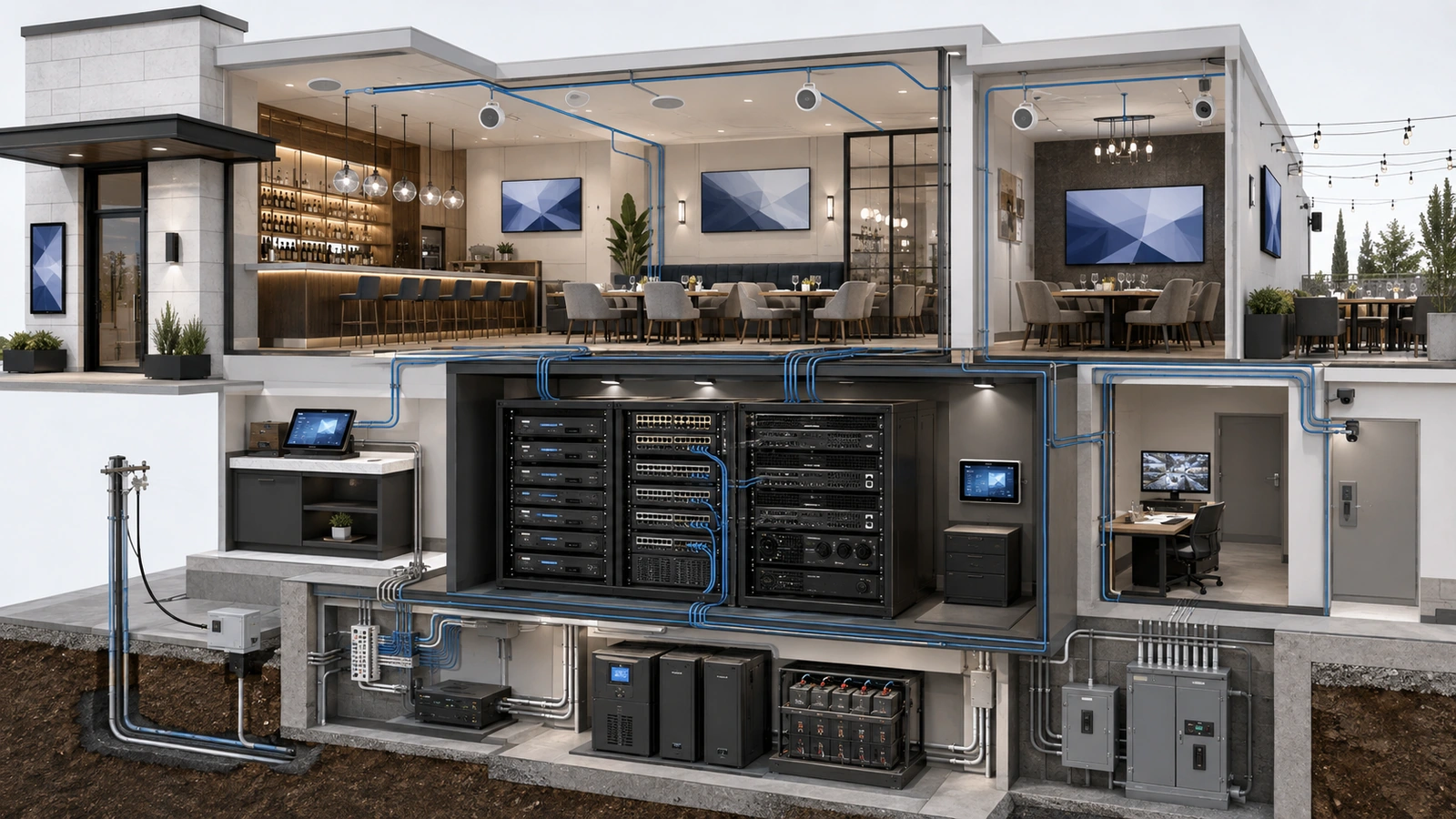
03 Calculate Streaming and Distribution Requirements
Streaming video creates sustained internet traffic, but the required capacity depends on how content is delivered.
Several televisions may:
- Stream different content independently
- Display the same source from separate internet sessions
- Receive one locally distributed source
- Use a managed commercial television platform
- Play locally stored or scheduled signage content
These designs create different internet and internal-network demands. Ten independent streams are not equivalent to one source distributed locally to ten displays.
Capacity planning should consider:
- Simultaneous content sources
- Expected resolution and delivery format
- Normal and event-based viewing patterns
- Internet overhead from other property services
- Gateway, switch, and uplink capacity
- Local unicast or multicast behavior where applicable
- Content caching or scheduled downloads
Internet capacity should be measured during representative operation. An advertised service rate does not guarantee that the content provider, ISP path, gateway, or streaming endpoint will deliver that performance continuously.
Fixed streaming devices and displays should use wired connections where practical. This reduces wireless airtime use and makes the connection easier to troubleshoot.
04 Design Audio as a Complete Signal Path
Networked audio may include streaming music, centralized processing, zone control, amplifiers, network endpoints, and mobile applications. Not every speaker is necessarily a network device, but the system may still depend on the network for its source and control.
The complete audio path may include:
- A licensed music or content source
- A streaming player or local source
- An audio processor or control platform
- Amplification
- Speaker wiring or networked audio transport
- Indoor, outdoor, bar, lobby, and event zones
- A staff control interface
A network interruption may stop the content source or controller while local amplification remains healthy. An amplifier or speaker-circuit problem can silence a zone even when the network platform reports normal operation.
Audio-system planning should also address:
- Independent volume and source control by zone
- Preventing unauthorized guest control
- Appropriate equipment-room ventilation
- Safe operating limits and staff permissions
- Outdoor exposure and speaker suitability
- Fallback content or silence behavior during internet loss
Network reliability is important, but it does not replace appropriate acoustic design, speaker placement, amplification, or professional system commissioning.
05 Plan Service Discovery and Network Boundaries
Some audio, casting, television, and control platforms rely on local discovery protocols. A controller may need to find a player or display before it can operate it.
Placing entertainment devices and controllers in different network segments can improve security and organization while interrupting discovery if the communication requirements are not understood.
The design should determine:
- Which controllers may discover which endpoints
- Whether discovery must cross network boundaries
- Which devices require direct local communication
- Whether guests are allowed to cast or control content
- How staff and vendor access differ
- Which internet destinations the platform requires
The answer should not be to combine POS, guests, entertainment, and management into one unrestricted network. Appropriate gateway functions, discovery controls, vendor-supported architecture, or dedicated controllers can preserve required operation without removing meaningful boundaries.
Rules should be documented narrowly. Broad access exceptions created only to make a control application work can expose unrelated systems and become difficult to remove later.
Segmentation Requires Application Awareness
Entertainment devices should remain separated from unrelated systems, but the design must intentionally preserve required discovery, control, synchronization, and internet communication.
06 Control Resource Competition
Logical separation protects access and simplifies troubleshooting. It does not automatically reserve internet capacity, wireless airtime, switch uplinks, or gateway resources.
Entertainment systems may still compete with:
- Guest internet usage
- Online ordering and reservations
- Cloud POS communication
- Remote surveillance viewing
- Software updates and cloud backups
- Staff and management activity
Fixed televisions, signage players, and audio components should generally be wired where practical. Wireless capacity should be preserved for mobile devices and locations where a cable is not feasible.
The property may apply appropriate traffic policy, schedule large updates outside service periods, or limit nonessential services during internet failover. These controls should protect operational priorities without creating unnecessary complexity.
Entertainment traffic should also be included in gateway and internet-capacity planning. A system that performs during normal dining service may need additional capacity during a major sporting event or property-wide function.
07 Coordinate Synchronization and Staff Control
Adjacent televisions showing the same event can create a poor guest experience when their video or audio timing differs noticeably. Separate streaming devices may buffer or process content independently, producing visible delay between displays.
Audio zones may also drift or become misaligned when the platform, transport, or endpoints are not designed for synchronized playback.
Where synchronization matters, the architecture should use a supported distribution method intended for that outcome rather than assuming independent streams will remain aligned.
Staff control should be simple and restricted. The property should determine:
- Who may change channels, sources, schedules, or volume
- Which control device remains at each operational location
- How credentials are stored and recovered
- What happens if a control tablet is lost or discharged
- Which vendor provides support
- How staff return the system to a known state
Personal employee phones should not become the only way to control business-critical entertainment. A dedicated, managed control method is easier to secure, document, and support.
08 Protect Outdoor Systems, Power, and Content Rights
Outdoor televisions, speakers, players, enclosures, and control equipment require environmental planning similar to outdoor Wi-Fi.
The design should address:
- Heat, humidity, rain, salt, dust, and ultraviolet exposure
- Viewing conditions and glare
- Weather-appropriate displays, speakers, mounts, and enclosures
- Protected network, signal, and speaker cabling
- Electrical service, grounding, surge, and lightning coordination
- Ventilation and drainage
- Physical security and maintenance access
Indoor streaming players placed inside sealed outdoor enclosures can overheat. Equipment mounted without accessible service paths may require extensive labor for routine replacement.
Power recovery also matters. Displays, players, processors, amplifiers, switches, and controllers may restart at different speeds. The system should return to a predictable state without requiring staff to visit every television.
Content rights must be verified independently from technical access. A subscription that allows personal viewing does not necessarily authorize public or commercial presentation. Music, sports, television, streaming, and signage content should use appropriate commercial services and agreements.
For exterior infrastructure planning, see Outdoor Dining Wi-Fi Strategy for Restaurants and Resorts.
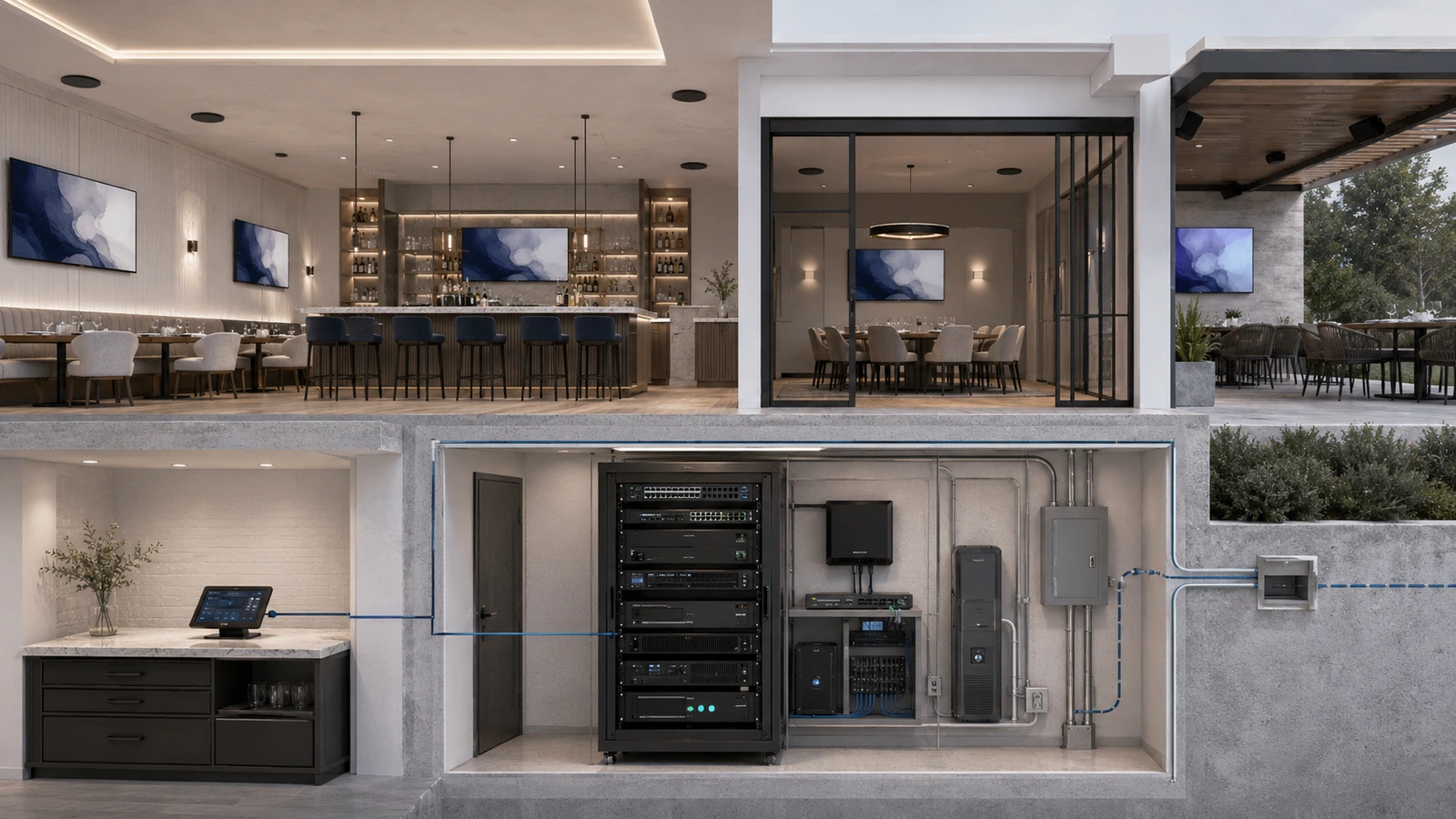
09 Commission and Document the System
Hospitality Entertainment Planning Checklist
- Inventory every source, player, display, processor, amplifier, zone, and controller
- Document device ownership, location, network path, and power source
- Confirm internet and local-distribution capacity during representative operation
- Use wired connections for fixed endpoints where practical
- Document discovery, control, synchronization, and segmentation requirements
- Verify guest, staff, vendor, and administrative permissions
- Test adjacent-display and multi-zone synchronization where required
- Validate normal startup, power recovery, and internet-loss behavior
- Confirm outdoor environmental and electrical requirements
- Verify commercial content, music, and presentation rights
- Record vendor contacts, licenses, subscriptions, warranties, and renewal dates
- Provide staff with simple operating and escalation procedures
Commissioning should test the complete operating experience. Staff should be able to select approved content, control the correct zone, recover from ordinary issues, and identify when escalation is required.
Testing should include busy periods and special-event configurations. A sports bar may behave differently when many displays show simultaneous content than during ordinary service. Outdoor systems should be tested under representative environmental and occupancy conditions.
Monitoring should help distinguish content-service failure, internet trouble, network interruption, player failure, display problems, controller access, and audio-path faults. Not every system exposes the same telemetry, so local status indicators and manual checks may remain necessary.
Entertainment infrastructure should also remain adaptable. Spare pathways, organized equipment, documented ports, modular distribution, and controlled vendor access make expansion easier without creating another layer of undocumented switches, routers, and power adapters.
Restaurant audio, television, and streaming systems become dependable when content delivery, local distribution, control, synchronization, power, environment, rights, and ownership are designed as one coordinated service.
The final category article addresses the governance needed to keep all these systems organized as vendors change and the property expands: Managing Multiple Technology Vendors in Hospitality Environments.