
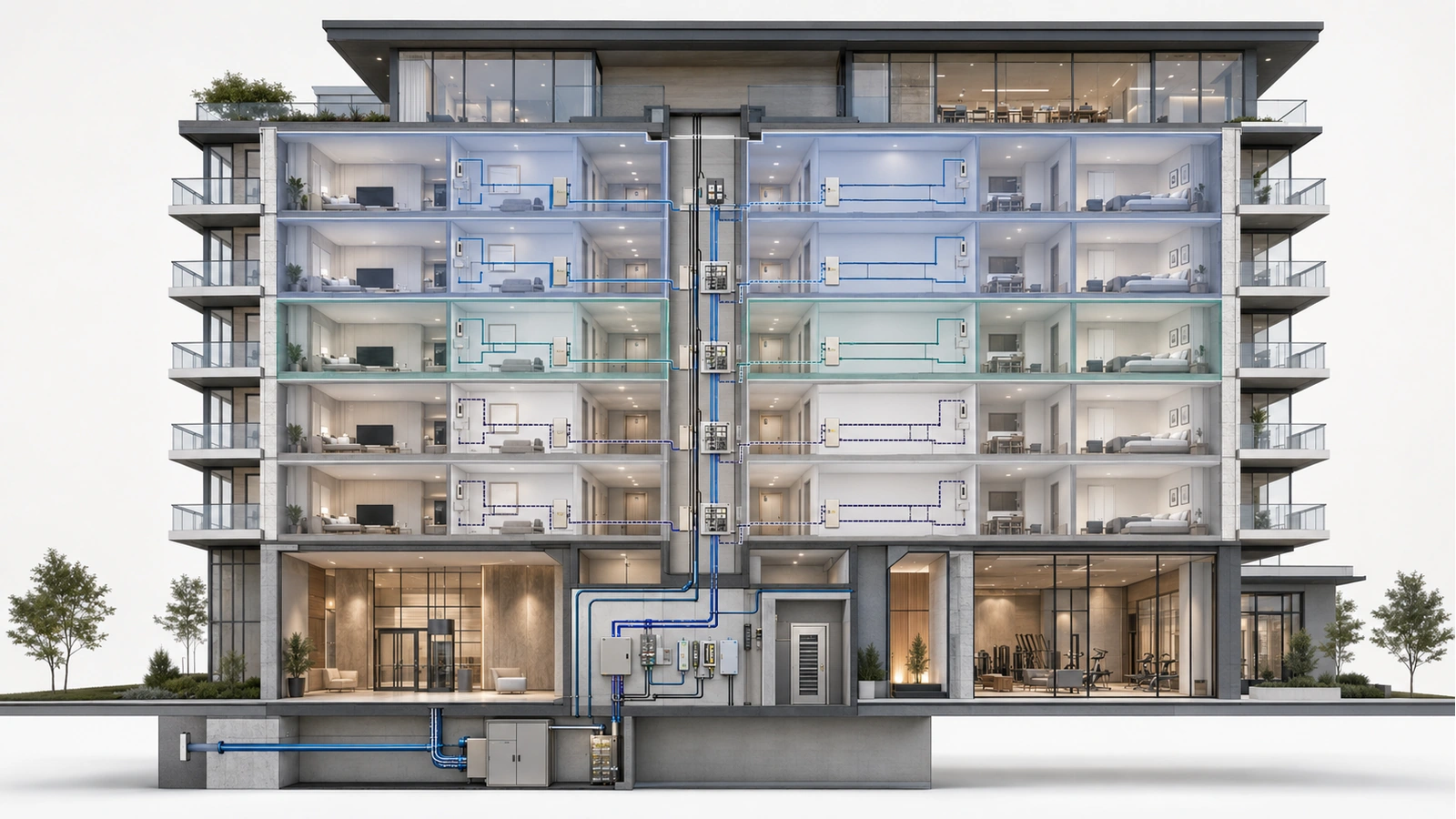
Should a multi-dwelling building provide connectivity as a managed property service, or should every resident purchase and operate an independent internet connection?
That question appears to describe a simple choice between a shared network and private networks. In practice, those terms can refer to several different things: physical cabling, internet capacity, network equipment, Wi-Fi coverage, ownership, administration, or communication between users.
A building can share fiber pathways while preserving completely separate provider services. It can centrally manage network equipment while assigning every household an isolated private environment. It can also leave resident internet entirely to outside providers while operating separate networks for common areas and property systems.
The right model is therefore not determined by whether something is technically “shared.” It depends on what the building promises residents, which responsibilities it accepts, and whether the architecture can enforce those boundaries reliably.
Key Takeaway
Shared infrastructure does not require shared resident access, and centrally managed connectivity does not require residents to see one another’s devices. Physical sharing, service delivery, tenant isolation, provider choice, and operational ownership must be evaluated separately.
01 Define What “Shared” and “Private” Mean
Before comparing models, the project team should define exactly which layer is being discussed.
Physical infrastructure
Conduits, risers, fiber, telecommunications rooms, racks, and distribution equipment may be shared by many services. Sharing these resources does not automatically place residents on the same logical network.
Internet service
A property may purchase centralized internet capacity and distribute it to residents, or each unit may contract directly with a provider. These arrangements affect billing, capacity planning, outage responsibility, and support.
Resident network
Even when the building provides the internet service, each household should receive an appropriately isolated environment. Residents may have private credentials, devices, policies, and in-unit connectivity while using centrally managed infrastructure.
Wi-Fi service
Building-managed Wi-Fi can cover units, common areas, or both. Resident-owned Wi-Fi can operate behind individual services. These approaches can coexist, but their coverage and radio-frequency effects must be understood.
Ownership and administration
The building, an internet provider, a managed-service operator, or a combination of parties may own and administer different components. Ownership determines who may change configurations, respond to failures, access monitoring data, and replace equipment.
Without these definitions, stakeholders may approve a “private” model expecting provider choice while the contract creates exclusivity—or approve a “shared” model without realizing that the association has accepted resident-support responsibilities.
02 Understand the Building-Managed Service Model
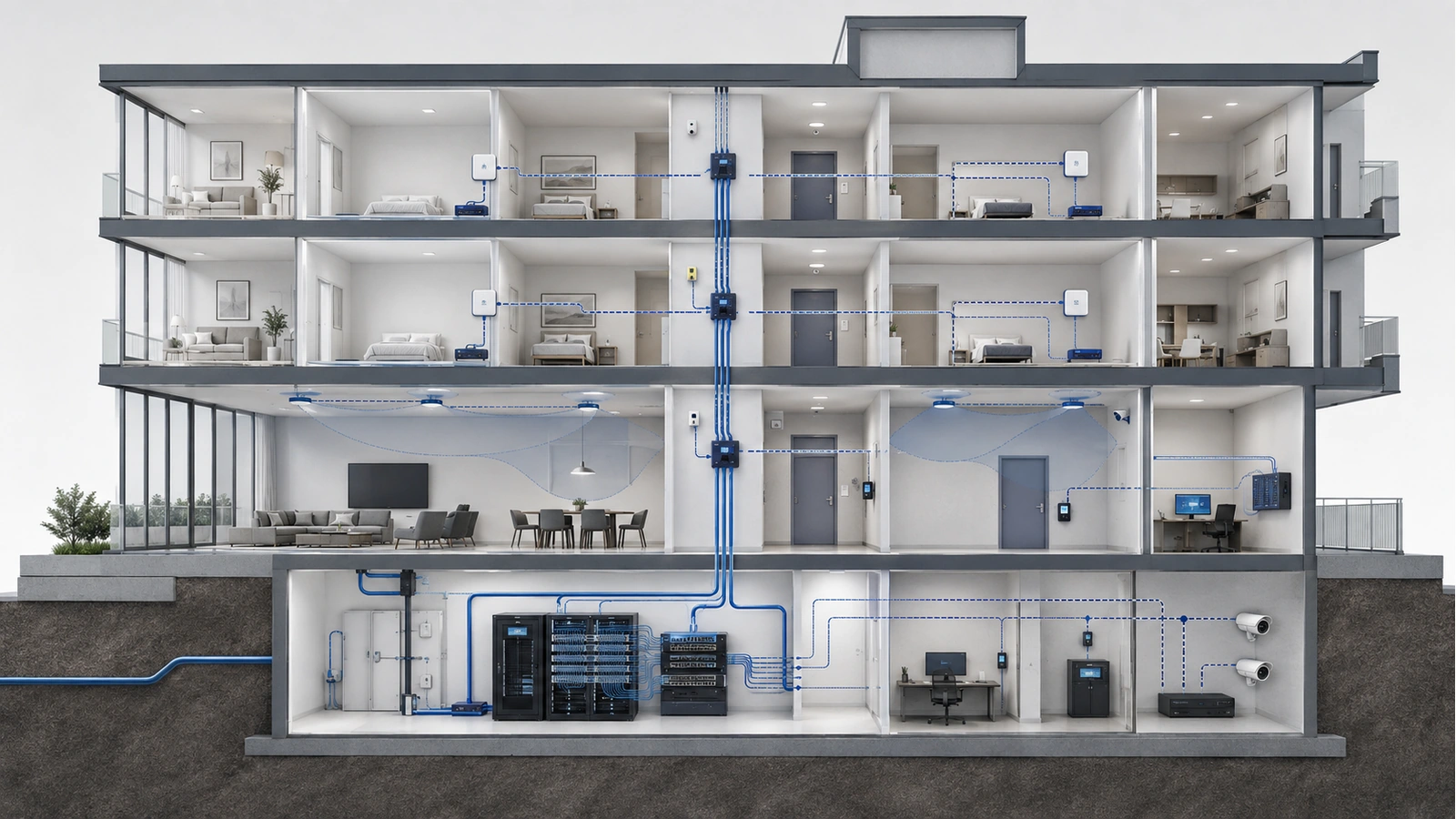
In a building-managed model, the property or its contracted operator provides connectivity as part of the resident experience. Internet capacity, distribution equipment, authentication, and often Wi-Fi are administered through a coordinated platform.
Residents may receive service automatically at move-in, through an association agreement, as part of rent, or through available service tiers. The exact commercial structure varies, but the building becomes closely involved in service delivery.
A well-designed managed model can provide:
- Consistent onboarding and standardized service delivery
- Central visibility into infrastructure health
- Coordinated wireless design where the building provides Wi-Fi
- Managed tenant isolation and security policy
- Integrated coverage in units, corridors, amenities, and outdoor spaces
- A clearer platform for hospitality-style or smart-property services
These benefits come with substantial responsibilities. Someone must monitor the environment, maintain licensing, manage resident changes, protect administrative systems, coordinate repairs, replace equipment, respond to outages, and determine whether a reported problem belongs to the building network or the resident’s device.
A managed network should be treated as an ongoing service, not a construction feature that becomes complete after installation.
03 Understand the Independently Subscribed Model
In an independently subscribed model, residents generally select service from an available provider and maintain their own account. The provider may install or activate a gateway, and residents may operate their own routers, Wi-Fi systems, and connected devices.
This can offer:
- Direct billing between the provider and resident
- Resident choice among available providers and service tiers
- A familiar support relationship for individual households
- A clearer limit on the property’s responsibility for in-unit performance
- Independent resident upgrade and equipment decisions
However, “private” service does not necessarily mean the building has no responsibility. The property may still own pathways, unit cabling, telecommunications rooms, or the passive infrastructure used by providers. Management may also need to coordinate technician access and investigate building-wide pathway or power failures.
Independent subscriptions also do not solve every wireless problem. Many neighboring routers and mesh systems can compete for the same spectrum. Residents may select poor equipment locations, use excessive channel widths, or add repeaters that increase radio congestion.
Consumer Wi-Fi can still be appropriate inside independently served units. The limitation is not simply the equipment category; it is the combination of density, construction, placement, configuration, and lack of coordination.
04 Use Hybrid Models Intentionally
Many properties use hybrid arrangements because resident connectivity and building operations have different requirements.
Common hybrid models include:
- Private resident internet with building-managed common-area Wi-Fi
- Building-owned pathways and fiber used by independent providers
- Managed resident connectivity with optional resident-owned in-unit Wi-Fi
- One provider serving units while the building operates separate security and operations networks
- Base connectivity included by the property with optional resident upgrades
- Managed Wi-Fi in selected units or amenities while other units retain private service
A hybrid model can preserve resident choice while allowing the building to manage the environments it directly controls. It can also support gradual modernization in an existing property.
The risk is ambiguity. If both the resident and building operate wireless equipment inside the same unit, who supports coverage? If the building owns the fiber but a provider controls the electronics, who repairs an optical failure? If base service is included, who handles upgrades and billing disputes?
Hybrid arrangements work when boundaries are deliberate, documented, and communicated. They perform poorly when they emerge from disconnected installations and informal assumptions.
| Decision Area | Building-Managed Service | Independent or Hybrid Service |
|---|---|---|
| Resident onboarding | Can be coordinated and move-in ready through a managed platform. | Usually handled through individual provider activation or account setup. |
| Provider choice | May be limited by the building’s commercial and technical arrangement. | Can preserve choice where multiple providers and usable pathways exist. |
| In-unit support | The building or operator may own more of the resident experience. | The provider or resident usually handles more in-unit troubleshooting. |
| Wireless coordination | Can be centrally designed when the managed service includes unit Wi-Fi. | Resident-controlled radios provide flexibility but less coordination. |
| Security model | Requires scalable tenant isolation and disciplined administration. | Independent service creates separate service boundaries, while shared building systems still require protection. |
| Operational burden | Requires monitoring, maintenance, resident processes, and lifecycle funding. | Reduces resident-service involvement but retains pathway and building-system responsibilities. |
05 Design Privacy and Tenant Isolation Explicitly
A shared service must never be interpreted as an unrestricted network on which residents can discover or reach one another’s devices. Each household needs an appropriate security boundary.
Isolation may be implemented through a combination of:
- Subscriber authentication and automated provisioning
- Dedicated logical network assignments
- Private VLAN or client-isolation functions
- Virtual routing and firewall policy
- Managed residential-gateway configurations
- Identity-based wireless access
- Provider-managed subscriber platforms
Assigning one VLAN to every unit is one possible technique, but it is not the only model and may become operationally cumbersome without automation. The objective is reliable separation, controlled access to authorized services, and a provisioning process that remains accurate as residents move in and out.
Building systems must also remain separate from resident and guest environments. Cameras, access control, management workstations, automation systems, and vendor interfaces require their own policies regardless of whether resident internet is shared or independently subscribed.
The next article, Network Security and Segmentation in High-Density Residential Buildings, examines these controls in greater depth.
06 Evaluate Performance and Wireless Responsibility
Neither model guarantees better performance by itself. A building-managed service can be undersized, poorly monitored, or badly designed. An independent service can perform extremely well inside a properly wired unit with correctly placed equipment.
Performance depends on the complete service path:
- Upstream internet capacity and provider architecture
- Building entrance and backbone capacity
- Distribution equipment and uplinks
- Unit delivery method and demarcation
- Gateway and wired-network capability
- Access-point placement and radio design
- Resident device capability and local interference
If the building promises managed unit Wi-Fi, it should establish measurable coverage and support expectations. If it provides only an Ethernet or optical handoff, that boundary should be equally clear.
Private resident networks reduce the building’s ability to coordinate radio settings, but they allow households to select equipment and coverage strategies that fit their units. Building-managed Wi-Fi provides greater coordination, but the operator assumes responsibility for design quality, onboarding, monitoring, and resident experience.
Service Promise Determines Support Responsibility
If the property markets managed connectivity or unit-wide Wi-Fi as an amenity, residents will reasonably expect the property or its operator to resolve service problems. The technical boundary and the resident-facing promise must match.
07 Compare Lifecycle Cost, Not Installation Price
A private-service model may require less building-owned active equipment, but the property may still need pathway improvements, provider coordination, room upgrades, and building-system networks. A managed model requires greater investment in service platforms, monitoring, support, security, and equipment replacement.
A useful financial comparison should include:
- Pathway, riser, fiber, and horizontal-cabling construction
- MDF and IDF improvements
- Network, security, wireless, and backup-power equipment
- Provider or managed-service contracts
- Licensing, monitoring, and cloud-platform costs
- Resident onboarding and ongoing support
- Equipment replacement and software maintenance
- Outage response and after-hours escalation
- Documentation and administrative management
- Contract transition or vendor-replacement costs
Potential revenue or association-wide pricing should be evaluated carefully against contract duration, participation obligations, service-level commitments, and the property’s ability to change direction later.
The lowest initial proposal may create an expensive dependency if the building cannot reuse its pathways, cabling, or unit connections with a future provider.
08 Protect Resident Choice and Vendor Flexibility
Provider choice is partly a commercial issue and partly an infrastructure issue. A building may technically permit multiple providers but lack the pathway capacity, room space, unit access, or distribution facilities needed to support them practically.
Before accepting a long-term service arrangement, the property should determine:
- Who owns installed fiber, cabling, and resident-facing equipment
- Whether the infrastructure remains if the contract ends
- Whether another qualified operator can reuse it
- How residents obtain upgrades or optional services
- What performance and support obligations are contractually defined
- How pricing may change during the agreement
- What happens during provider acquisition, failure, or withdrawal
- How data, configurations, credentials, and documentation are transferred
A managed service can be highly effective without creating unnecessary lock-in when the building retains suitable passive infrastructure, complete records, and clearly negotiated transition rights.
Similarly, independent resident service does not create meaningful choice when only one provider can physically reach the units.
09 Choose the Model Through Governance
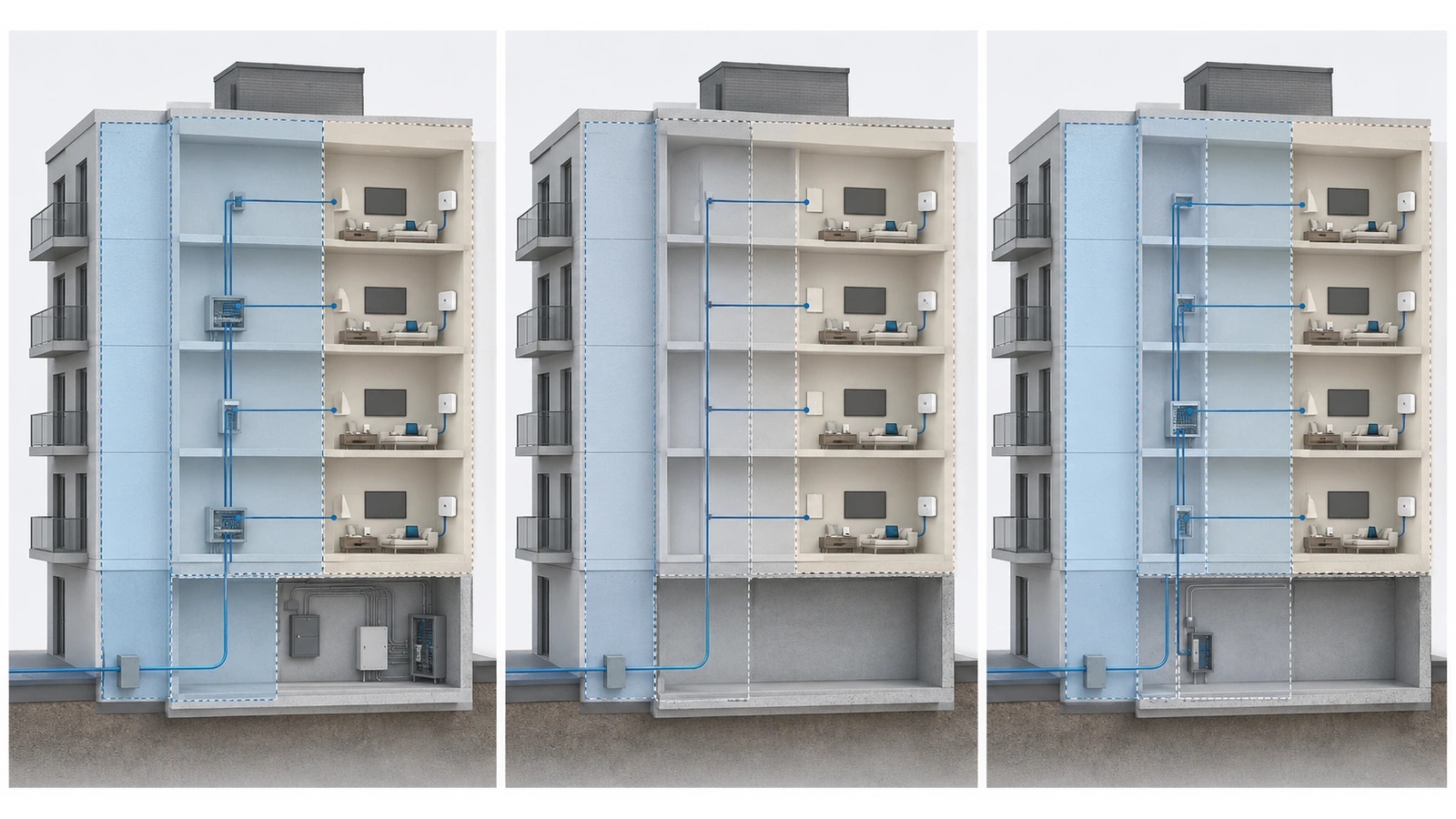
The final decision should reflect how the property intends to operate—not merely what an installer or provider prefers to sell.
Shared, Private, or Hybrid Decision Checklist
- Define which resident and building services are included
- Identify the owner of every major passive and active component
- Document provider, building, operator, and resident demarcation points
- Determine whether residents require provider or equipment choice
- Define how households and building systems remain isolated
- Specify who supports internet, gateways, wired networks, and Wi-Fi
- Establish performance, coverage, availability, and escalation expectations
- Calculate installation and ongoing lifecycle costs
- Review contract duration, renewal, transition, and infrastructure rights
- Document move-in, move-out, credential, and equipment-return procedures
- Confirm monitoring, privacy, logging, and administrative-access policies
- Plan how the building can change providers or service models later
A condominium association may prioritize resident choice and limited operational involvement. A rental or hospitality-style property may value standardized, move-in-ready connectivity. A mixed-use building may need several models operating in parallel.
None of these outcomes is automatically correct for every property. The strongest architecture is the one whose technical boundaries, contracts, staffing, resident expectations, and financial responsibilities all tell the same story.
Shared and private networks should not be treated as opposite ends of one simple spectrum. An MDU can share physical infrastructure efficiently while maintaining strong private boundaries, or it can provide centrally managed resident service without combining households into one unrestricted network.
Once the service model is selected, the property must translate those boundaries into enforceable security controls. Continue with Network Security and Segmentation in High-Density Residential Buildings.